Translate IMF Financial Statements with Doc2Lang
A Complete Walkthrough from Upload to Download
This article provides a detailed walkthrough of translating the IMF (International Monetary Fund) Annual Financial Statements from English to Japanese using Doc2Lang's PDF translation service, with a systematic analysis of the results.
Challenges in Translating Financial Documents
Financial statement translation is one of the most demanding categories in document localization. Compared to general documents, financial statements pose several unique challenges:
- Dense Accounting Terminology:Financial reports contain extensive specialized vocabulary under IFRS/GAAP standards, and translations must accurately correspond to official accounting terms in the target language.
- Complex Table and Number Formatting:Financial statements typically include multi-column tables, merged cells, and indentation levels. Translations must preserve number alignment and visual structure.
- Diverse Page Elements:Headers, footers, footnotes, and appendices must be fully preserved without disrupting their positional relationships.
- Highly Specialized Actuarial Terminology:Reports from international organizations like the IMF often include pension and insurance reserve content with highly specialized actuarial terminology.
Test Document Details
Document Source
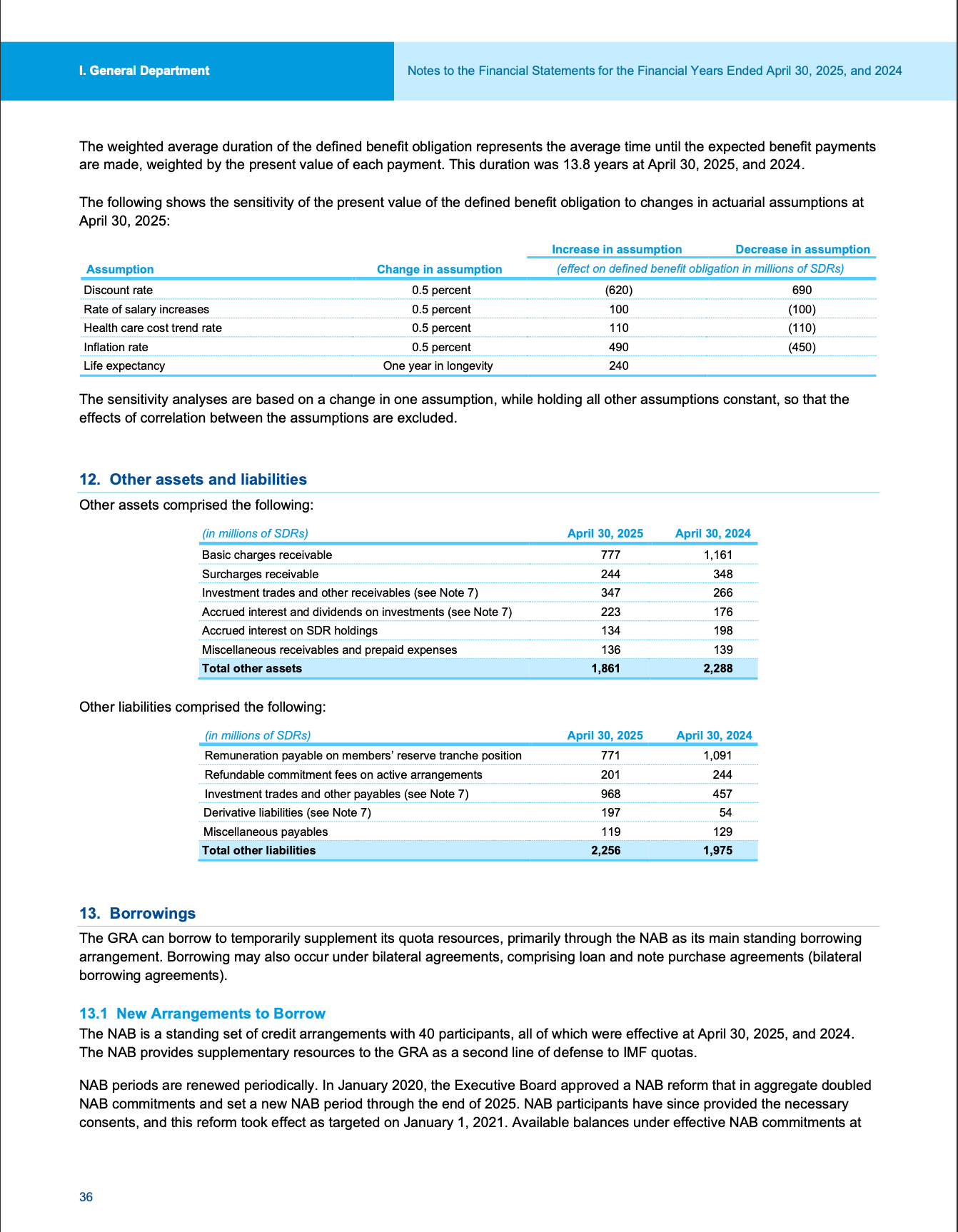
IMF Annual Report – Financial Statements 2025
Translation Direction
English → Japanese
Document Format
PDF (multi-page tables)
Translation Service
Doc2Lang PDF Translate
Key Document Features:
- Includes core financial statements: balance sheet, income statement, and cash flow statement
- Numerous multi-column data tables with strict number formatting (thousands of USD)
- Clear hierarchy of section headings and subheadings
- Contains actuarial notes for defined benefit pension plans
- Headers include the organization name and report year
Original PDF Screenshot:
Translation Steps
Here is the complete workflow for translating IMF financial statements using Doc2Lang:
Upload the PDF File
Go to the Doc2Lang homepage and drag and drop the IMF financial statement PDF into the upload area, or click the "Choose File" button. The system automatically detects the PDF format.
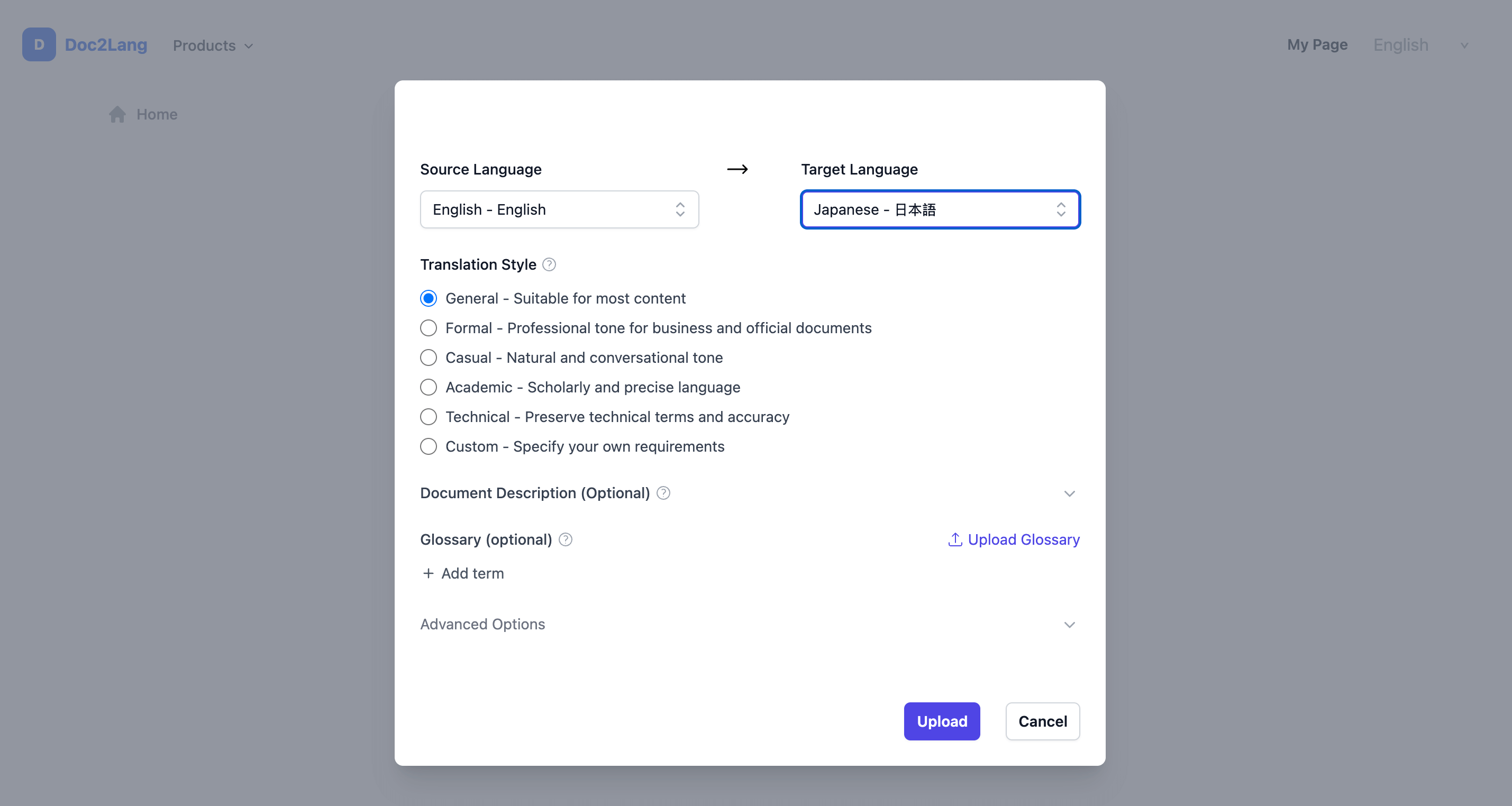
Select Languages and Start Translation
In the settings panel, set the source language to "English" and the target language to "Japanese," then click the "Translate" button. The system begins processing the PDF, extracting text and invoking the AI translation engine.
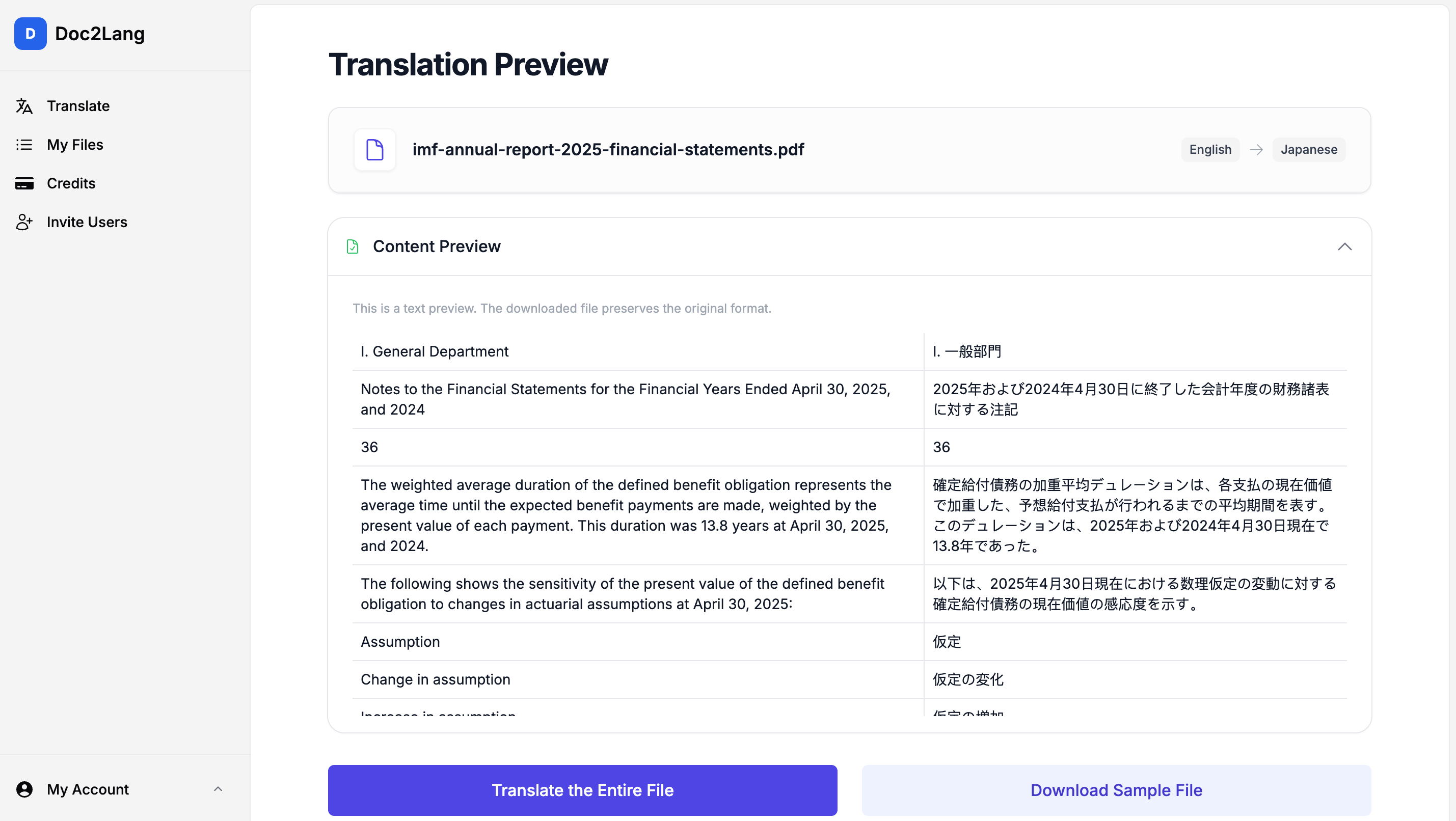
Preview the Translation
After translation is complete, you enter the preview page. You can view the translated PDF content online, including table formatting, headers and footers, and section headings. A partial preview is available for free to evaluate quality.
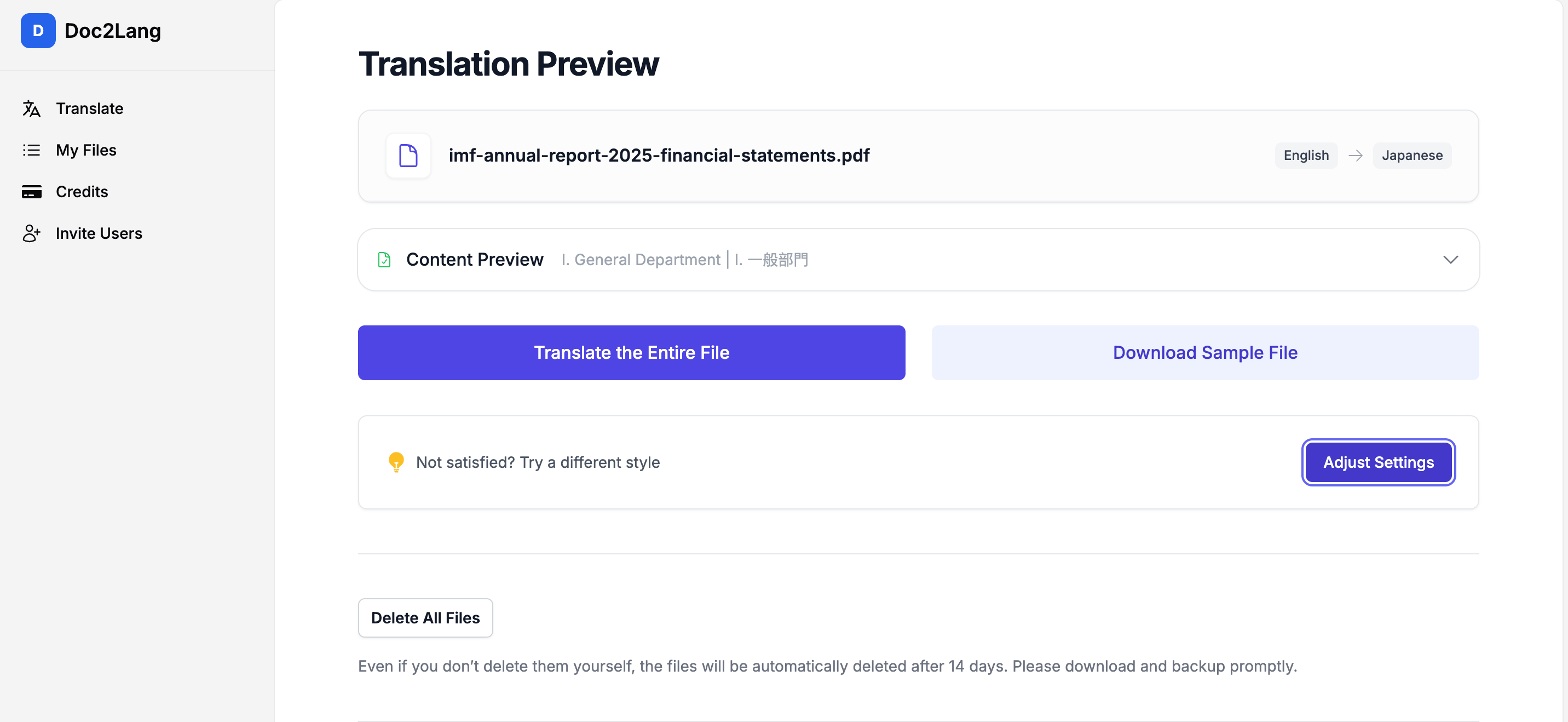
Complete Payment
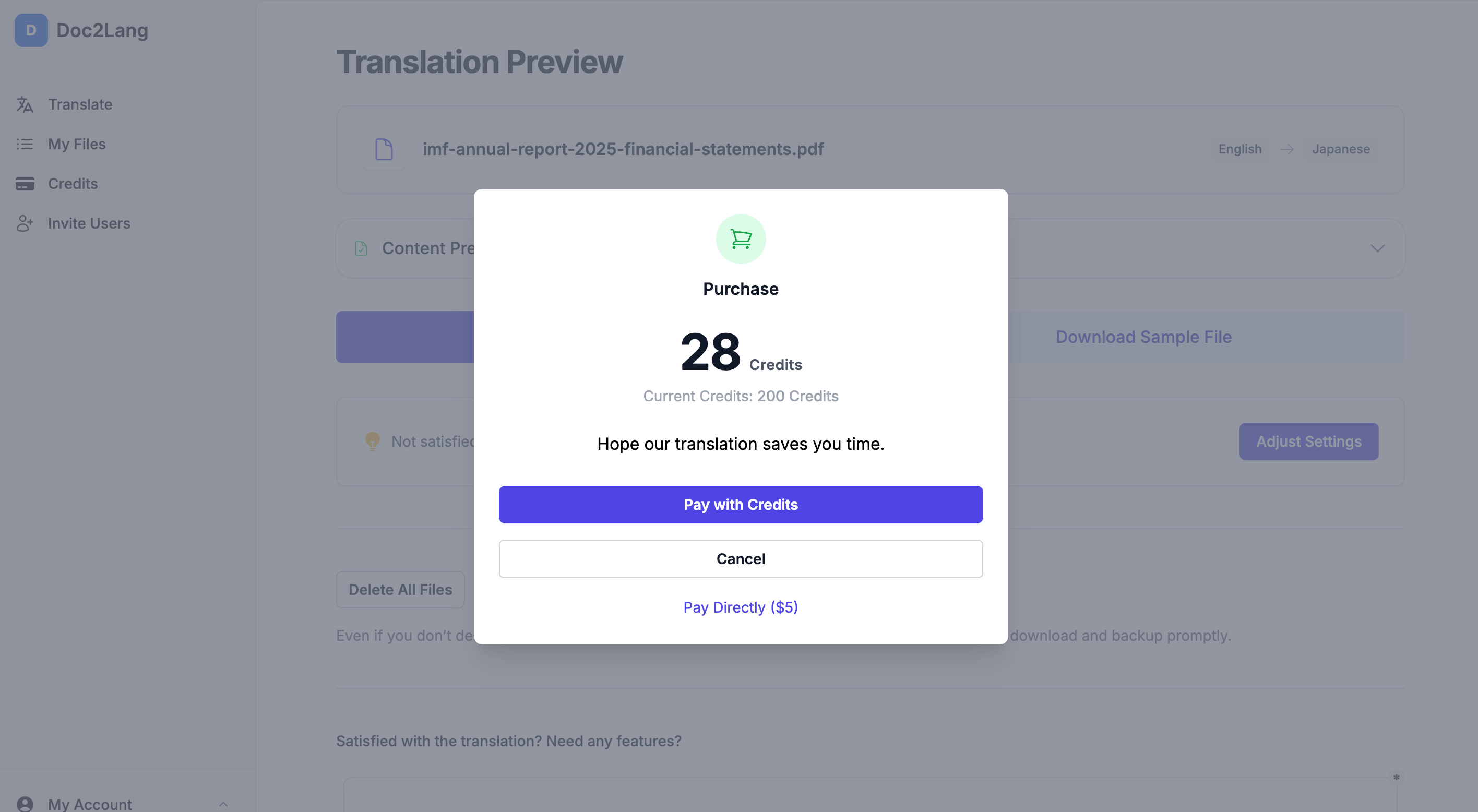
Once satisfied with the preview, select the appropriate plan based on the document's page count and complete payment. Doc2Lang uses a pay-per-use model with no subscription required.
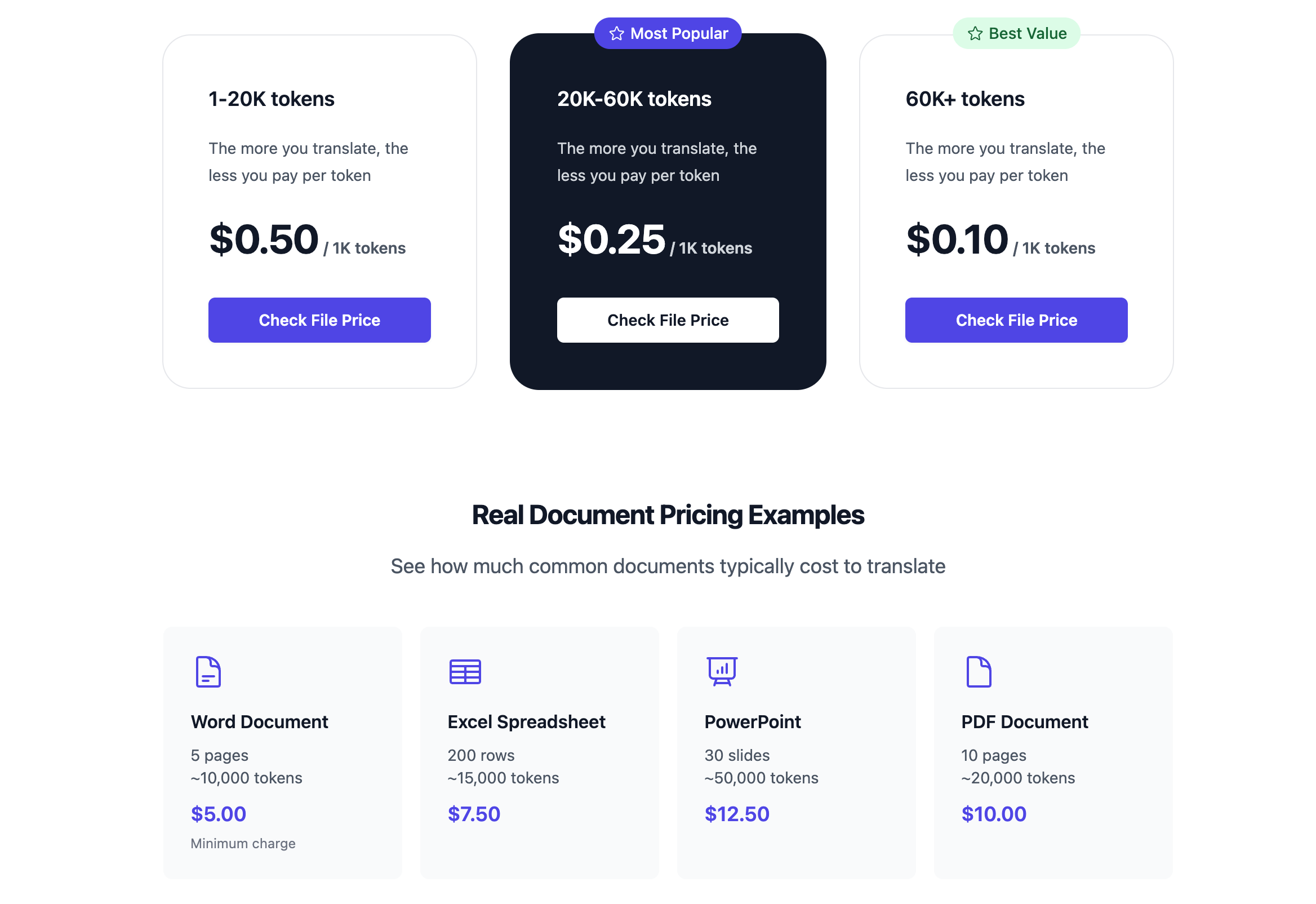
Doc2Lang document translation starts at $5. Translating documents within 5 pages costs around $5. Pay-as-you-go with no subscription required.
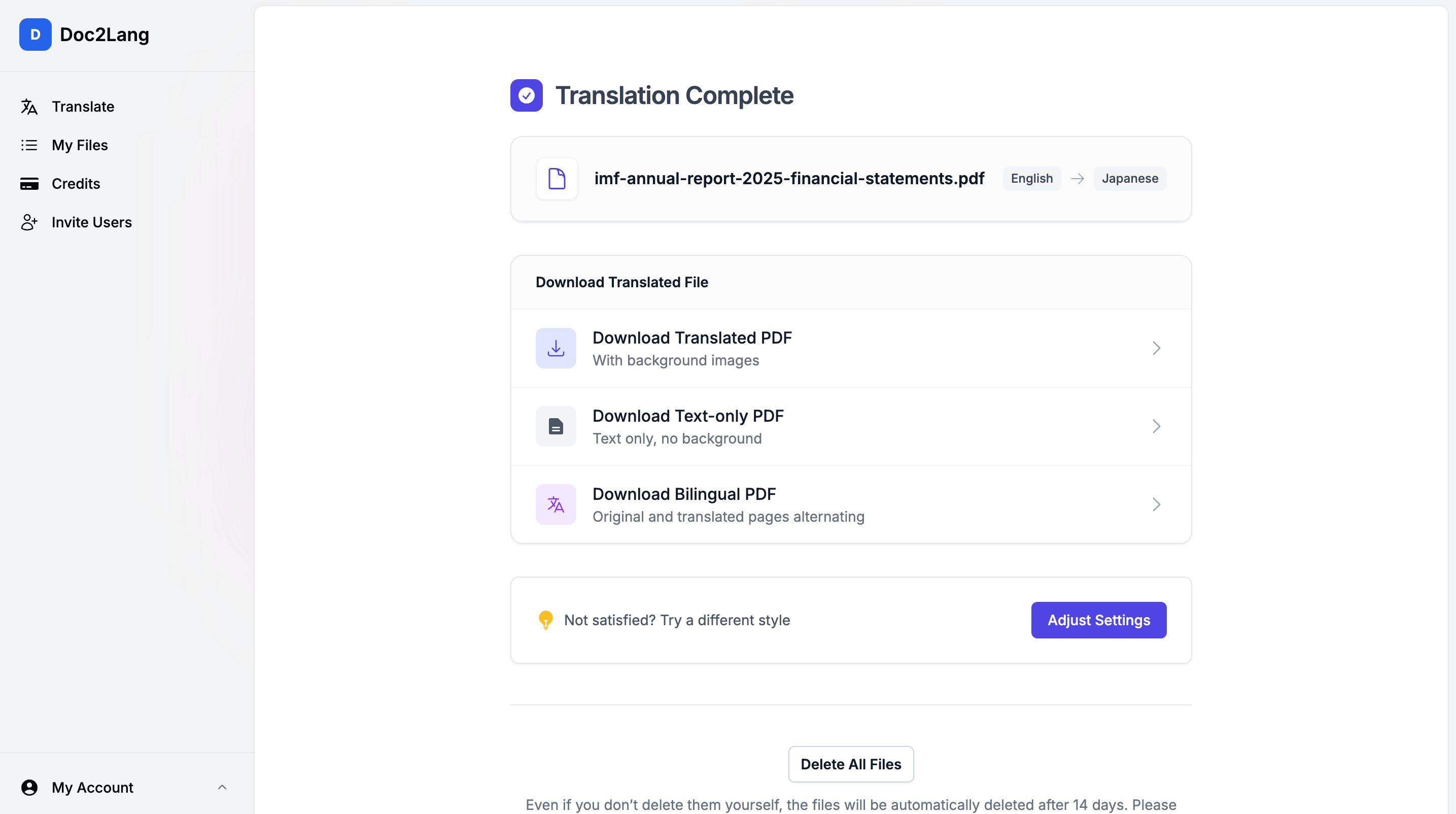
Download the Translated File
After payment, you can immediately download the fully translated PDF. The downloaded file matches the original PDF format, preserving all original formatting and layout.
Translation Results Analysis
1. Layout Preservation (Layout Fidelity)
This is where financial PDF translation most commonly breaks down. Here are our observations.
Section Headings (Blue Background + White Text)
The source document uses full-width blue rectangular bars with white text to mark major sections (e.g., "I. General Department").
The translation output renders as 「I. 一般部門」, where:
- ✅Blue background color preserved
- ✅White text rendering maintained
- ✅Position and width consistent with the source
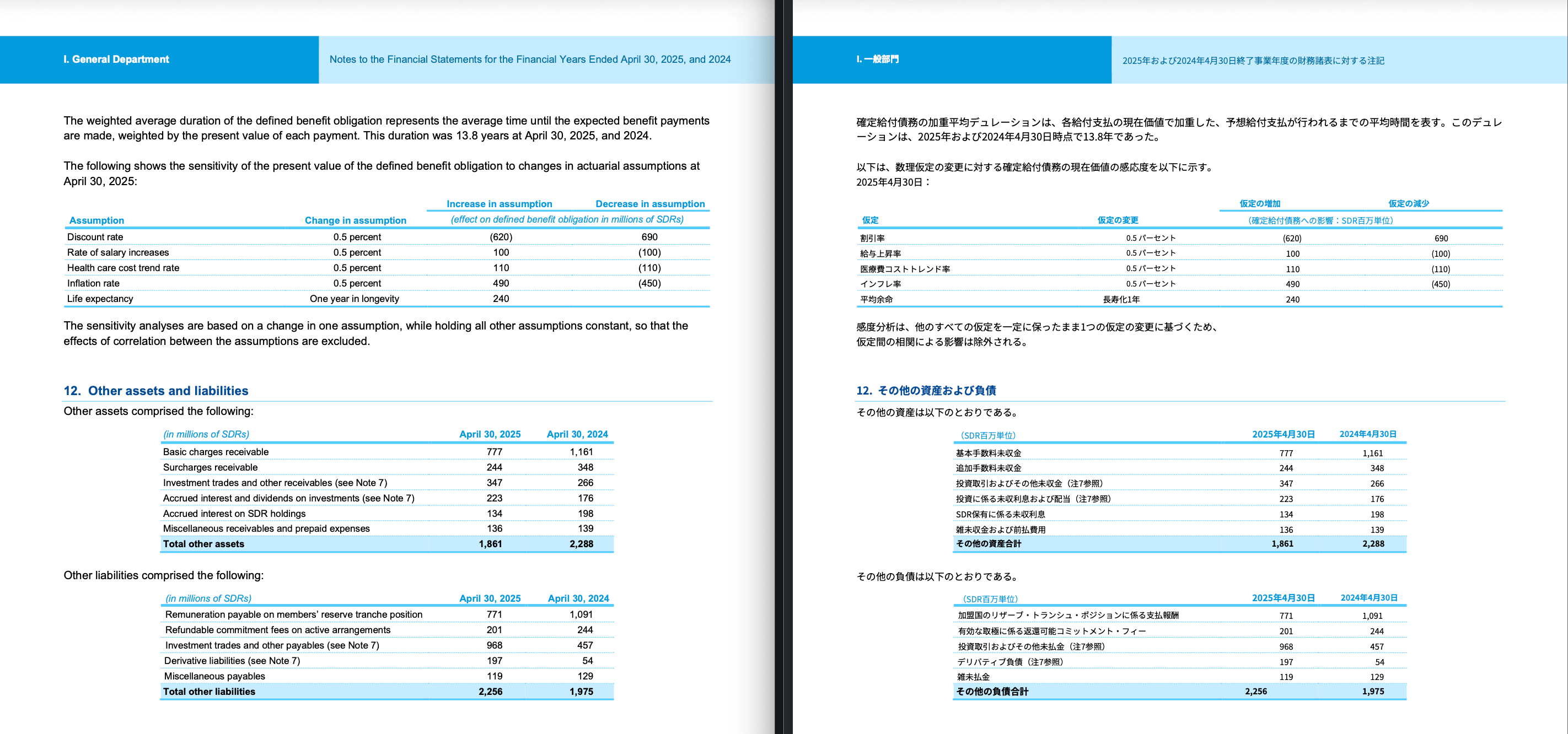
These blue headings are not decorative — they mark the boundaries of IMF organizational units such as the General Department, SDR Department, and others. Losing this visual structure forces readers to guess where each section begins.
Financial Data Tables
We focused our inspection on Schedule 12 ("Other Assets and Liabilities") because this table contains:
- •Date columns (e.g., April 30, 2025)
- •Multiple numeric columns in SDR millions
- •Row labels of varying length
In the translation output:
- ✅Dates correctly converted to 「2025年4月30日」
- ✅Numeric columns are precisely vertically aligned — each number sits directly below its column header
- ✅Row labels do not overflow into adjacent columns after translation
- ✅Unit notation correctly converted to 「(SDR百万単位)」— no confusion between SDR and yen, consistent with Japanese financial statement conventions
Note: In the third chart, the last label shows a slight positional shift — the translated text is correct, but compared to the source there is a few-pixel displacement. This does not affect readability, but is noticeable upon close comparison. We are currently working on improving this.
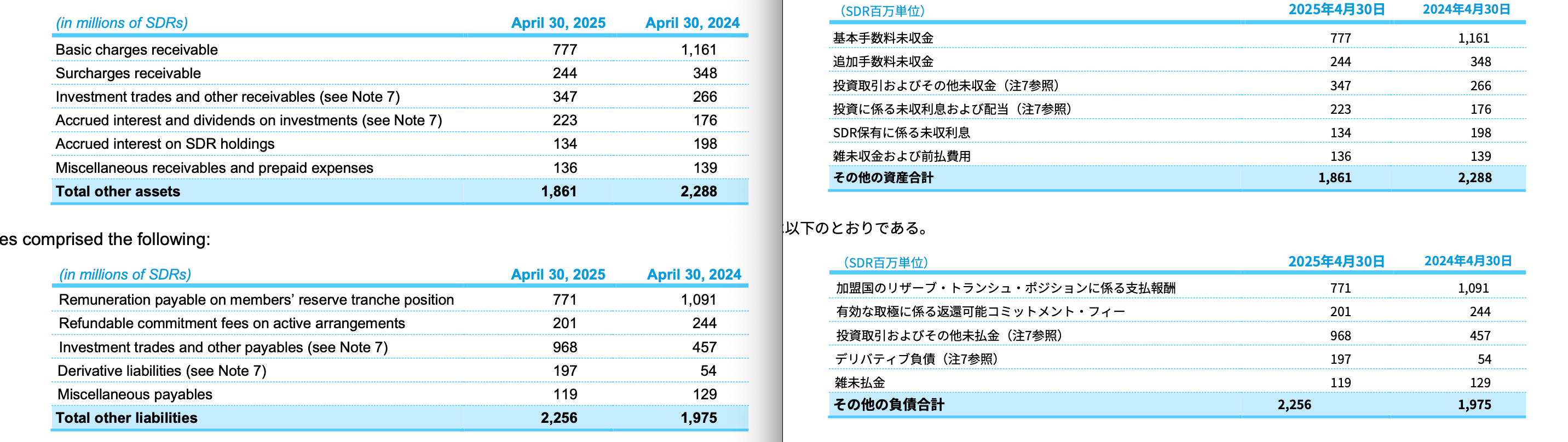
Column alignment may seem like a detail, but in financial documents it is critical. When numbers in the "debit" column visually drift toward the "credit" column, it creates interpretive ambiguity. In our output, alignment is precise.
Page Structure
- ✅Page numbers retained in their original positions
- ✅Footnote superscript numbers correctly correspond between body text and footnote areas
- ✅Headers and footers consistent throughout the document
2. Translation Quality: Financial Terminology
Financial document terminology has standardized translations — especially for international institutions like the IMF. Using generic translations instead of official terms makes a document appear unprofessional and can even cause confusion.
How Doc2Lang handles key terminology:
Accounting Line Items and Financial Terms
| Source Text (English) | Translation Output (Japanese) | Notes |
|---|---|---|
| Borrowings | 借入 | As a section heading, translated as an activity concept rather than an account name |
| Other Assets and Liabilities | その他の資産および負債 | Standard balance sheet terminology |
| Basic charges receivable | 基本手数料未収金 | IMF charges translated as 「手数料」 |
| Surcharges receivable | 追加手数料未収金 | Consistent with Basic charges |
| Miscellaneous payables | 雑未払金 | Accurately reflects the meaning of "Miscellaneous" |
| Miscellaneous receivables and prepaid expenses | 雑未収金および前払費用 | Consistent terminology style with 雑未払金 |
| (In millions of SDRs) | (SDR 百万単位) | Correct — no confusion between SDR and yen |
| Remuneration payable on members' reserve tranche position | 加盟国のリザーブ・トランシュ・ポジションに係る支払報酬 | IMF-specific terminology, handled correctly |
| Refundable commitment fees | 返還可能コミットメント・フィー | Correct |
| Derivative liabilities | デリバティブ負債 | Standard financial terminology |
Regarding the translation of "Borrowings," Doc2Lang rendered it as 「借入」 rather than 「借入金」. In the source text, "Borrowings" serves as a section heading describing borrowing activities and mechanisms, not as a balance sheet line item — making 「借入」 the more contextually appropriate choice. If it appeared as a B/S line item, the correct translation would be 「借入金」. This ability to differentiate translations based on context is precisely the advantage of context-aware translation.
Actuarial and Statistical Terms
| Source Text (English) | Translation Output (Japanese) | Notes |
|---|---|---|
| Defined benefit obligation | 確定給付債務 | Standard pension accounting terminology |
| Weighted average duration | 加重平均デュレーション | Uses specialized financial katakana terminology |
| Actuarial assumptions | 仮定 | Correct |
| Sensitivity analyses | 感度分析 | Correct |
| Discount rate | 割引率 | Standard |
| Rate of salary increases | 給与上昇率 | Correct |
| Health care cost trend rate | 医療費コストトレンド率 | Japanese + katakana hybrid, acceptable |
| Inflation rate | インフレ率 | Standard |
| Life expectancy / One year in longevity | 平均余命 / 長寿化 1 年 | Actuarial terminology handled accurately |
Overall, Doc2Lang demonstrates a high level of expertise across institutional terminology, accounting line items, and actuarial concepts found in IMF financial statements. The majority of terms are consistent with those used in official IMF Japanese publications and Japanese Ministry of Finance documentation.
3. Sentence-Level Quality
Stylistic Consistency
The entire output uses formal report-style Japanese:
- •Sentence endings: 「〜である」「〜行われることもある」「〜とする」 used consistently throughout
- •No mixing of polite form (です/ます) and plain form (である)
- •Appropriate use of passive constructions common in Japanese financial writing
This consistency matters. A financial report that switches between formal and colloquial tone mid-paragraph looks like it was stitched together from different sources.
Paragraph Fluency
Japanese sentence structure differs significantly from English (verb-final, topic-comment structure, etc.). The translation avoids "translationese" — that stilted style where you can clearly tell the original was in English. The paragraphs read like natural Japanese financial writing.
Important Notes
- Some IMF-specific abbreviations (e.g., SDR for Special Drawing Rights, Executive Board) are retained in English to match the original document format.
- In rare cases, deeply nested tables (more than 3 indentation levels) may show slight formatting shifts. We recommend cross-referencing with the original.
- Charts and graphics (image-based elements) in the PDF are not text-translated; the original images are preserved.
- For custom terminology (such as company or product names), you can set up a glossary before translation to ensure consistent translations of key terms.
Doc2Lang Translation Characteristics: What We Observed in This Test
Highly faithful to the source text with virtually no omissions
In our paragraph-by-paragraph review, we found that Doc2Lang rarely omits source information. For example, "all of which were effective" was fully rendered as 「そのすべてが有効であった」, and "expected" in "expected benefit payments" was captured as 「予想される給付金支払い」. These easily overlooked details are preserved throughout — critically important in financial documents where a single missing qualifier could alter the legal meaning of an entire sentence.
Terminology aligned with official IMF usage
We cross-referenced the translation output against publicly available Japanese publications from the IMF and Japan's Ministry of Finance, and found that Doc2Lang consistently uses standard domain terminology such as 「取極」(arrangements), 「クォータ」(quotas), and 「デュレーション」(duration). This terminological consistency shows the system is not simply performing generic translation, but recognizing the financial document context and matching appropriate specialized vocabulary.
Accurate handling of grammatical relationships in complex sentences
Financial statements frequently contain long sentences with multiple layers of modification. For instance, descriptions of sensitivity analysis for defined benefit obligations involve nested structures like "the sensitivity of A to changes in B." We found that Doc2Lang accurately preserves the logical relationships between subjects, objects, and modifiers, avoiding the common pitfalls of subject-object inversion or modifier ambiguity.
Use of katakana loanwords — specialist-friendly, though general readers may need adjustment
We observed that Doc2Lang tends to use katakana loanwords for certain terms, such as 「デュレーション」(duration), 「コミットメント・フィー」(commitment fee), 「デリバティブ」(derivative), and 「リザーブ・トランシュ・ポジション」(reserve tranche position). These are entirely standard representations in international financial literature. Notably, in the updated translation, "note purchase agreements" was rendered as 「手形購入契約」 rather than the katakana 「ノート購入契約」, demonstrating the system's ability to choose between kanji and katakana based on context — prioritizing kanji for terms with well-established Japanese equivalents. However, for non-specialist target audiences, some katakana terms may still warrant adjustment during review.
Practical Tips
- Prioritize Text-Based PDFs:Selectable-text PDFs (not scanned documents) yield the best translation results. For scanned PDFs, we recommend running OCR first.
- Make Full Use of the Preview:Before payment, take advantage of the free preview to check the translation quality of key pages (such as the cover and important tables).
- Set Up a Glossary:For frequently occurring proper nouns (fund names, organization names, etc.), set standard translations in the glossary beforehand to significantly improve consistency.
- Page-by-Page Verification:For high-precision financial reports, we recommend comparing the original and translated documents page by page to verify the accuracy of numbers and terminology.
Test Specifications
| Document Name | IMF Annual Report – Financial Statements 2025 |
| Document Format | |
| Source Language | English |
| Target Language | Japanese |
| Translation Service | Doc2Lang PDF Translate |
| Translation Date | February 2026 |
| Document Source | Publicly available document from the official IMF website |
We also have a detailed comparison of this document translated with Google Translate and DeepL.See the comparison
Translate Your Financial Documents Now
Whether it's IMF reports, corporate annual reports, or international financial statements, Doc2Lang helps you translate them efficiently while preserving professional formatting.