Translate Word (.docx) Documents Without Breaking the Layout
Just upload a .docx file. AI translates your document into English, Japanese, and 180+ other languages while keeping headings, tables, bullet lists, headers, and footers exactly as they were.
or drag and drop
Accepted format: Word (.docx). For an older .doc file, open it in Word and use Save As to convert it to .docx first.
- Start with no signup
- Preview before you pay
- Pay per use, no subscription
- Delete anytime, auto-deleted in 14 days
The layout stays, only the words change
Copy and paste the translation back yourself and the fonts, columns, and shape positions drift out of place. Doc2Lang keeps the document structure untouched and swaps only the text.
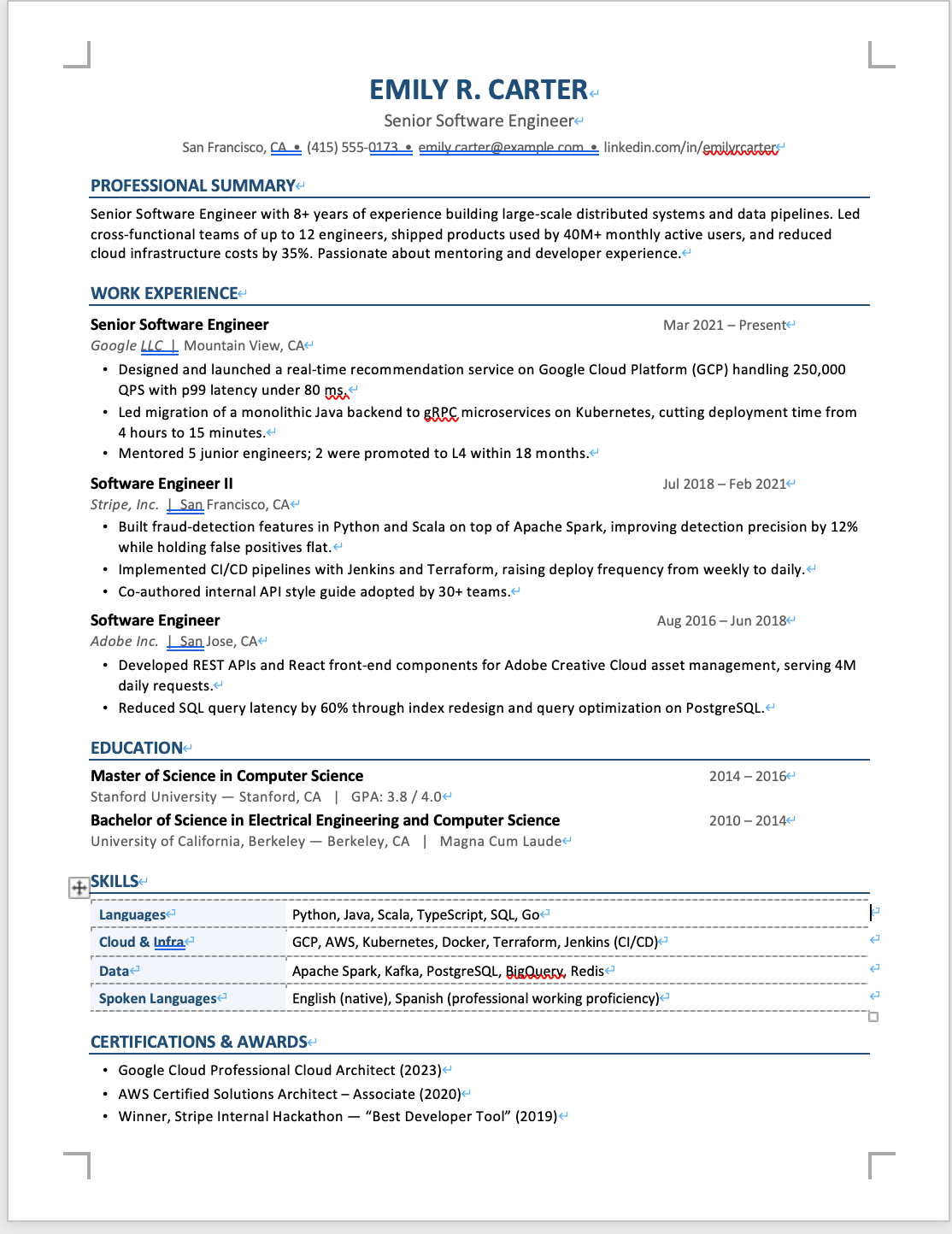
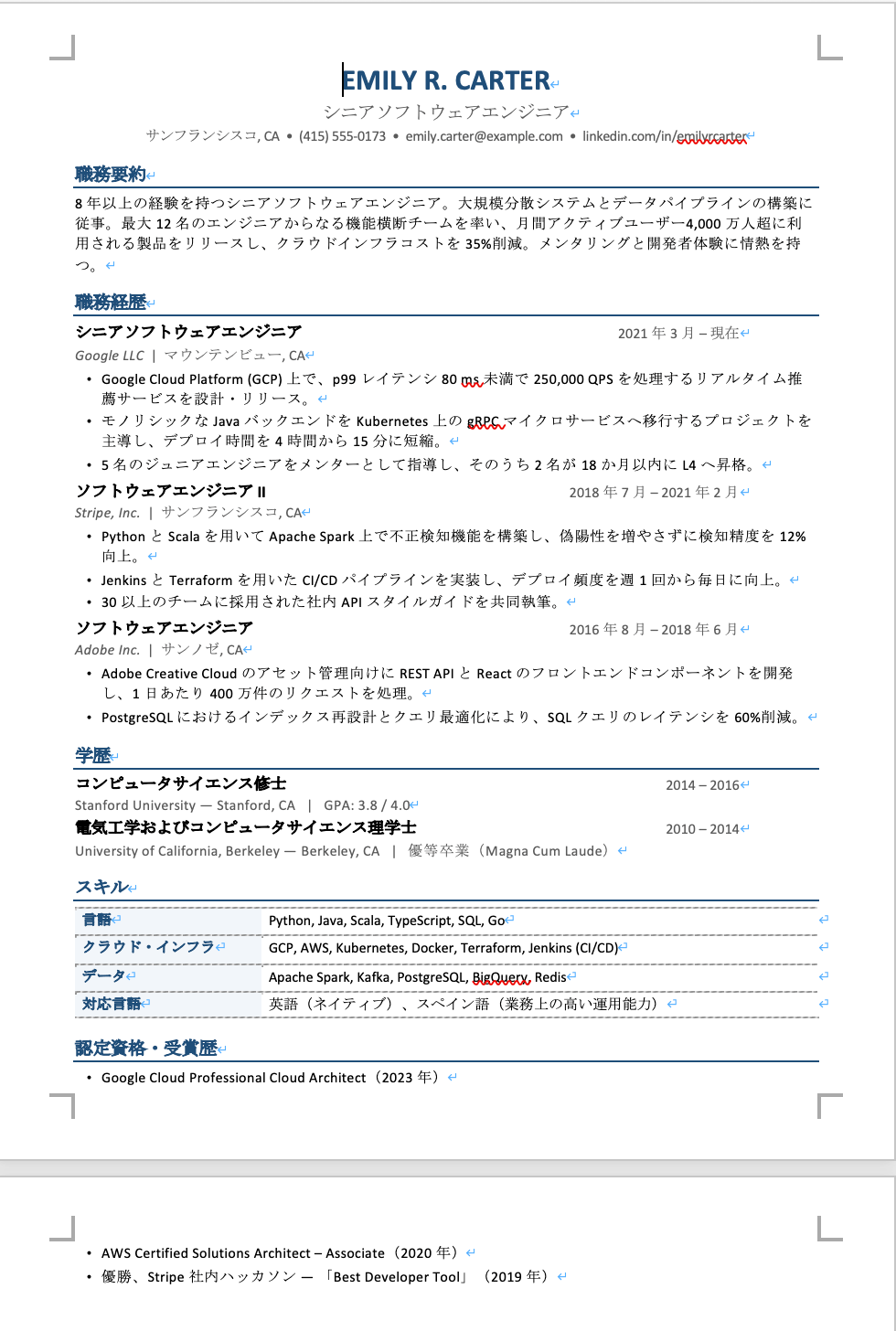
We checked this English resume field by field, and you can read the full record in our hands-on test of AI resume translation from English to Japanese.
What gets translated, and what does not
Here is the exact scope, based on what actually happens during processing, so you know before you upload.
| Document element | Translated | Notes |
|---|---|---|
| Body text | Yes | Paragraph styles, heading levels, and bullet-list hierarchy are all preserved. |
| Headers and footers | Yes | Translated just like body text. Fields such as page numbers stay as they are. |
| Text inside tables | Yes | Merged cells and borders stay put; only the text inside each cell is swapped. |
| Text in text boxes and shapes | Yes | Handled the same as body text. Complex layouts may need a little repositioning afterward. |
| Footnotes and endnotes | No | Left in the original language. Move anything important into the body before translating. |
| Comments and tracked changes | No | Not translated. We recommend accepting or resolving them before you upload. |
| Text inside images | No | Images are embedded as-is. Text baked into a picture is not translated. |
| Citation fields (EndNote, Zotero) | No | Citations inserted as field codes stay in the original language. |
The same engine handles Excel and PDF too. For spreadsheets, use translate Excel files online, and for scanned documents or papers, use translate PDF documents. How your files are handled is described in our privacy and data policy.
Three steps, start to finish
No account and no software to install. Everything happens in your browser.
- 1
Upload your .docx file
- Pick the source and target languages, then drag and drop your Word document. The accepted format is .docx.
- Choose the translation model: Pro for the best quality, or Lite when speed and cost matter more.
- Pick a translation style from General, Formal, Casual, Academic, or Technical, or write your own with Custom.
- Add a short document description, such as a maintenance manual for semiconductor equipment, to keep ambiguous terms translated consistently.
- Use a glossary to pin the wording of company names and technical terms across the whole document. You can save it and reuse it next time.
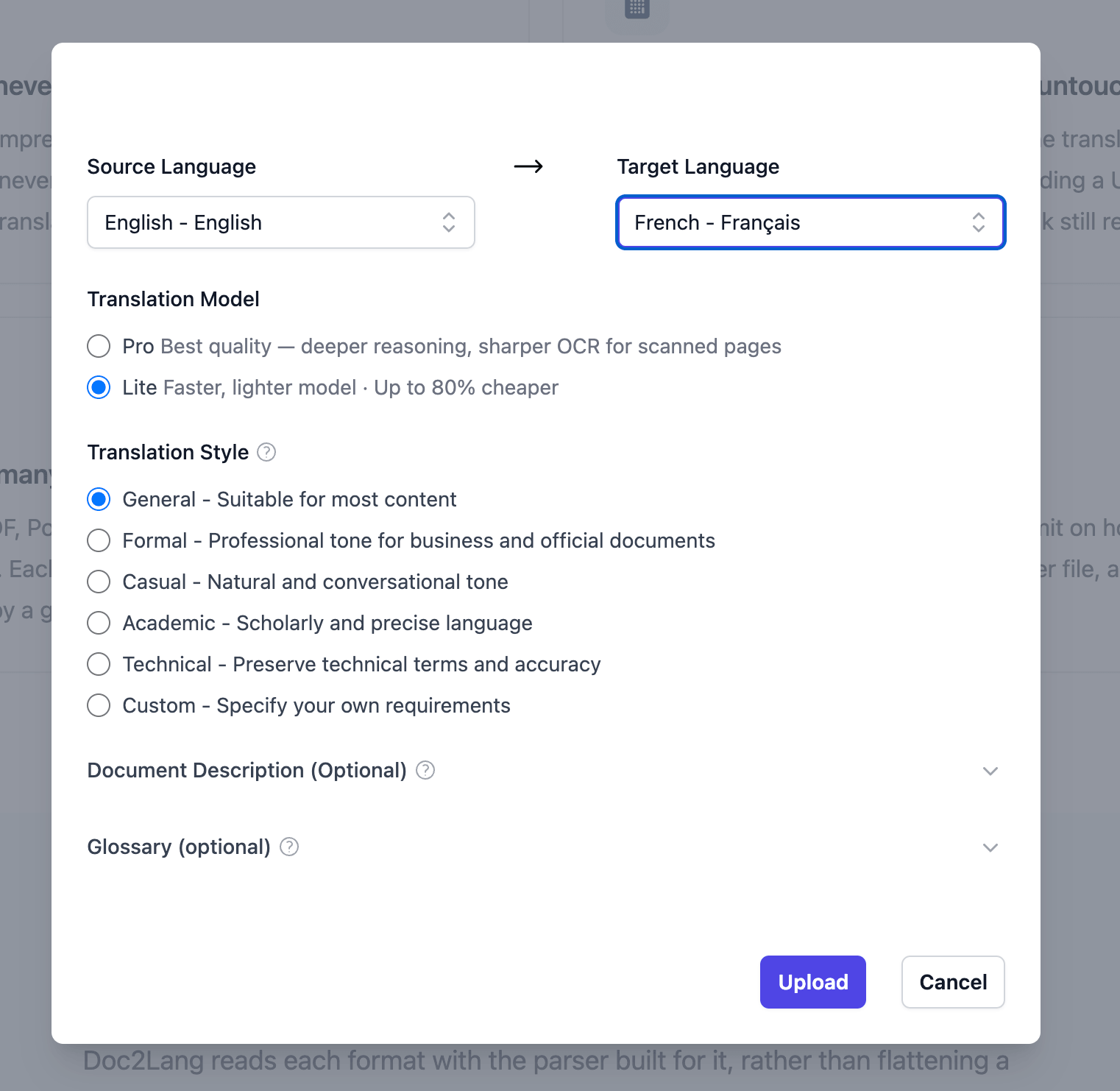
The settings panel shown at upload. You choose the model, translation style, document description, and glossary all on this one screen. - 2
Read the preview, then pay
- Part of the document is translated automatically, with source and translation shown side by side paragraph by paragraph.
- Nothing is charged at this point. If it does not meet your expectations, you can simply walk away.
- The preview is a text view. The file you download keeps the original formatting.
- There is no monthly plan. You pay per use based on how much you translate, with payment handled through Stripe.
- 3
Download it with the original formatting
- You get back a .docx file that keeps the layout of headings, tables, bullet lists, headers, and footers.
- You can delete the finished file at any time.
- Even if you do not delete it yourself, it is automatically removed after 14 days.
The kinds of documents people translate here
- Papers and research
- For translating a paper before submission or reading foreign-language literature. The Academic style keeps technical terms and the tone of the argument intact.
- Contracts and internal policies
- Translate without disturbing clause numbering or the bullet-list hierarchy. Use a glossary to keep defined terms consistent throughout.
- Proposals and reports
- Produce a translated version with tables and headers intact, so there is no layout to rebuild afterward.
- Resumes and CVs
- Create a version for applying abroad while keeping the shapes and photo placement of a design template in place.
Tips for keeping the layout intact
- Use heading styles
- Documents that use Word's built-in Heading 1 and Heading 2 styles are structured correctly, which improves the consistency of the translation.
- Keep key sentences out of text boxes
- Text inside text boxes and shapes is translated too, but because length changes between languages, it can overflow the frame.
- Choose common fonts
- Unusual fonts may not include characters for the target language. Widely used fonts such as Arial or Yu Gothic are the safe choice.
- Check embedded objects
- An Excel table pasted into the document, or text inside an image, is not translated. If you need it translated, paste it back as a Word table or as text.
Frequently asked questions
Can I use a .doc file from before 2007?
Only the .docx format is supported right now. Open the .doc file in Microsoft Word, choose Save As, select .docx, and save it again before uploading.
Are footnotes, endnotes, and references translated?
Footnotes, endnotes, and comments are out of scope and stay in the original language. What gets translated is body text and the text in headers and footers. A reference written as a body paragraph will be translated, but a citation inserted through an EndNote or Zotero field code stays as it is.
Is my original formatting preserved?
Paragraph styles, headings, bullet lists, tables, headers, and footers are all preserved. Between languages where length changes a lot, such as Japanese to English, you may need to adjust text-box sizes or where the page breaks fall.
Is it safe to upload confidential documents?
All traffic is encrypted over HTTPS, and you can delete an uploaded file at any time. Even if you do not delete it yourself, it is automatically removed after 14 days. We never use your documents as AI training data.
Can I check the quality before paying?
Yes. When you upload, a preview appears with part of the document translated, and nothing is charged at that point. You can read the result and then decide whether to translate the whole file.
Which languages can I translate my Word document into?
You can translate into more than 180 target languages, and in either direction, so English to Japanese or Japanese to English both work the same way. You pick the source and target languages on the upload screen.
Related guides
Articles to help you get more out of Word translation.
How to translate a resume to Japanese, a real AI before-and-after test
We translated an English resume into Japanese with the Pro model and checked the job titles, school names, dates, and layout against the actual output.
Translate many Word, Excel, and PDF files at once from a single ZIP
A walkthrough of bundling several files into a ZIP, uploading it, and translating them all in one go.
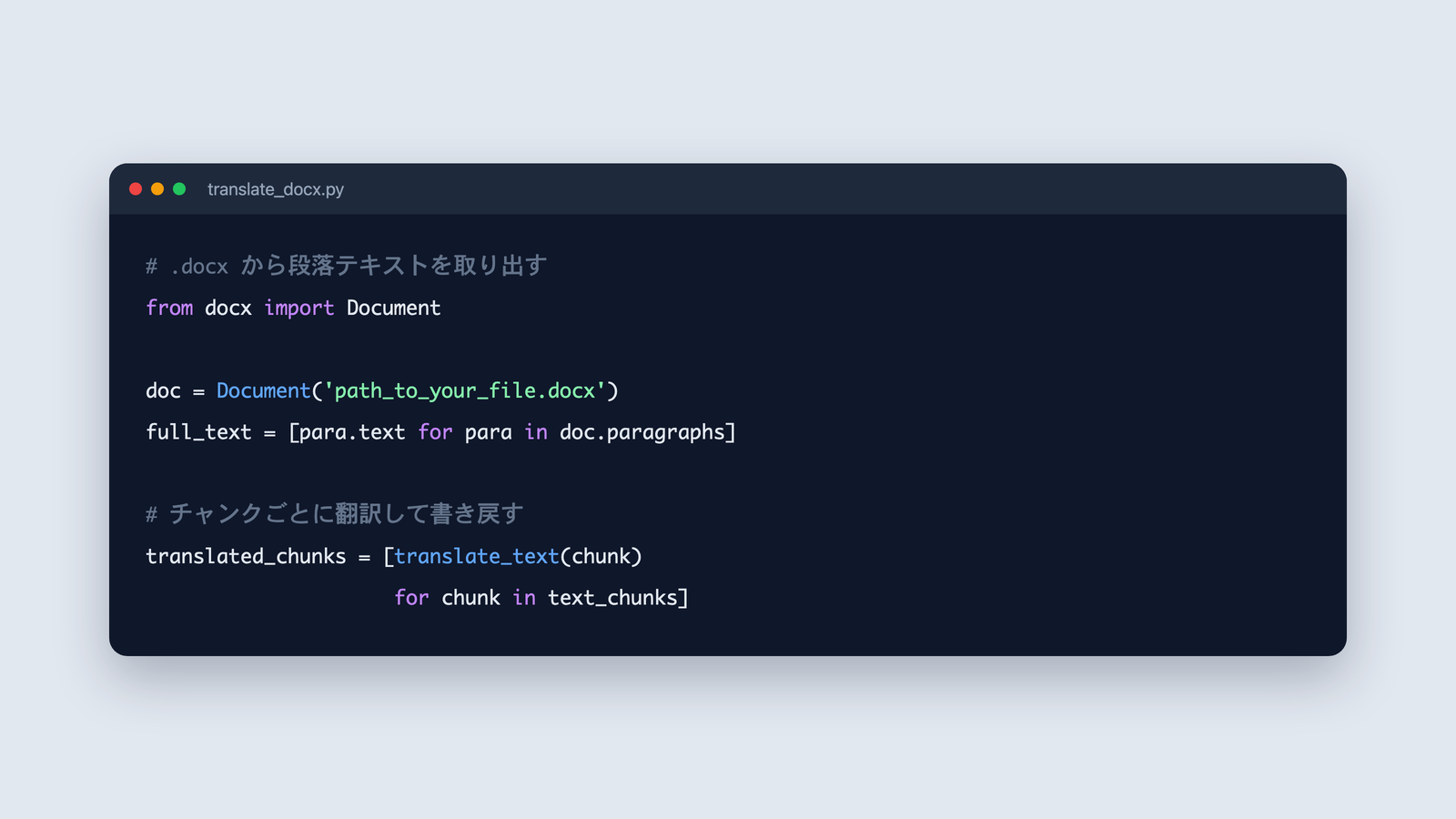
Automate .docx translation with Python and the ChatGPT API
Code for pulling paragraphs out of a .docx with python-docx, translating them through the API, and writing them back.
Translate your Word file now
Upload it and read the translation before you pay. No signup required.
Related Services
Explore other translation services that might interest you