Translate Excel to English: the Same Quotation in 8 Languages
How do you translate an Excel spreadsheet to English without wrecking it? We took one quotation, built it in 8 languages, translated all of them to English, and unzipped every file to check what survived. Merged cells, live formulas, currency formats and the embedded logo all came through intact.
If a supplier sends you a quotation in German, Japanese or Chinese, your problem is not looking up words. Your problem is that the moment you start pasting cells into a translator, the total stops being a formula and becomes a dead number, the merged header row falls apart, and the currency format vanishes. What you end up forwarding to your team is a spreadsheet that no longer adds up.
So this article skips the advice about cultural nuance. We built the same B2B quotation in eight source languages (Chinese, Japanese, Korean, German, French, Spanish, Italian, Portuguese), each with merged cells, live formulas, currency formats, an embedded logo and a block of payment and delivery terms. We translated all eight into English, then unzipped every output file and checked it cell by cell.
Being straight with you: these are demo files we built ourselves, translated with our own tool. This is a product demo, not an independent benchmark. But you do not have to take our word for anything below. Both files from the German run are downloadable at the end, so you can open them in Excel, click the total, and see for yourself whether the formula is still alive. If you want tools compared head to head, we have a separate piece that runs a real Apple 10-Q filing through six different translation methods.
What we found
- The file structure held in all 8 languages: every one of the 23 merged cells survived, and the line-item,
SUM,ROUNDand total formulas were still live formulas, not flattened numbers. - Tax terms were handled correctly per country: VAT for the European files, Consumption tax for Japan, ICMS for Brazil. A tool that called all of them "VAT" would be wrong.
- Incoterms and trade abbreviations were left alone: FOB Hamburg stayed FOB Hamburg, and a pro forma invoice was not "corrected" into a formal invoice, which is a different document.
You can translate an Excel file online right now and preview the result before paying. Or keep reading for what the output actually looks like.
Why Excel's built-in translate isn't enough
Most people start with Excel's own feature: Review → Translate. It exists, and it fails immediately, because it only translates the one cell you have selected. There is no "translate this sheet" option anywhere in it.
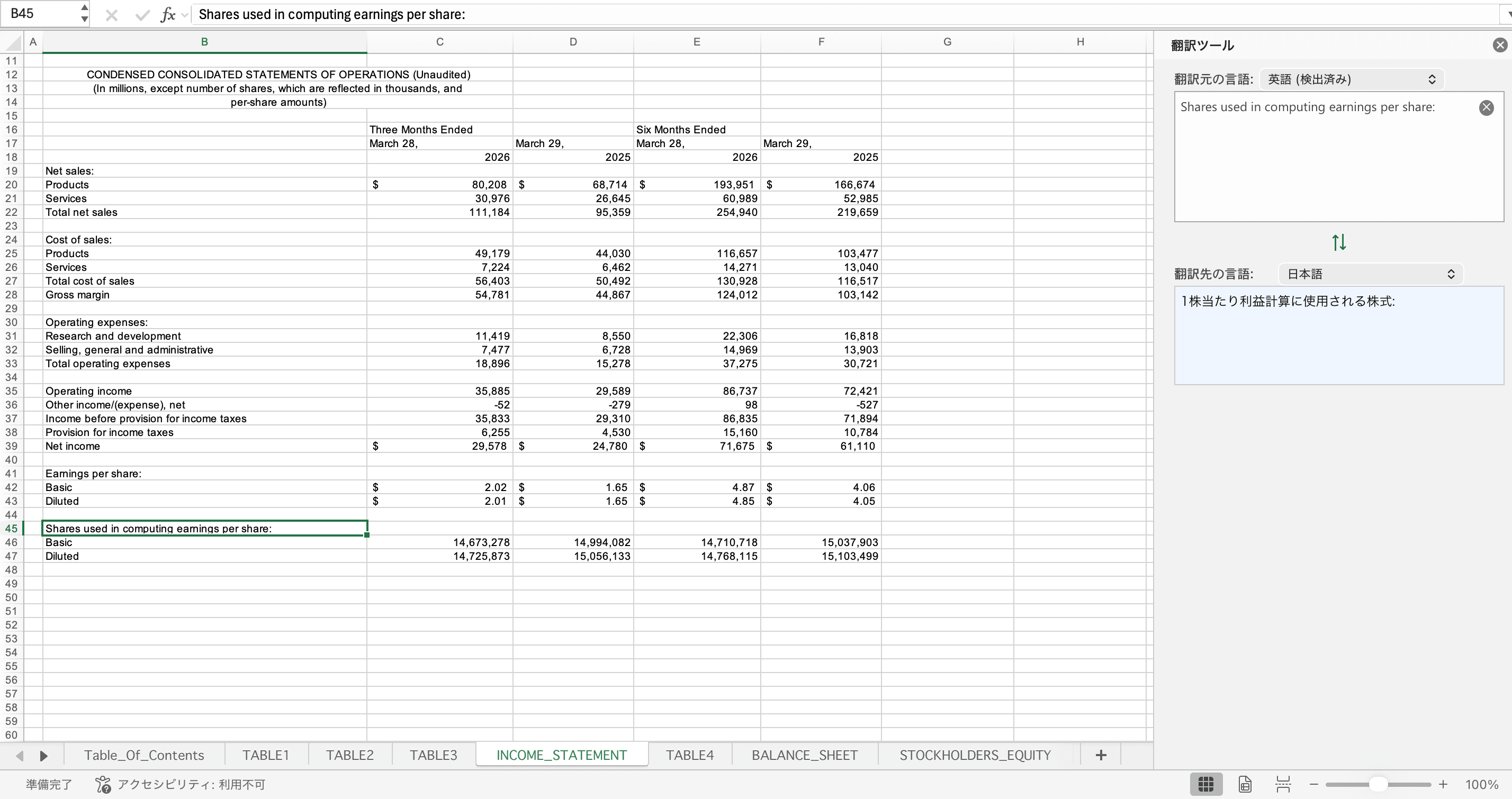
That is why people end up pasting into Google Translate or ChatGPT instead. Those solve the text. They do not solve the file, and the file is the part your finance team has to open.
The demo file: one quotation, eight languages
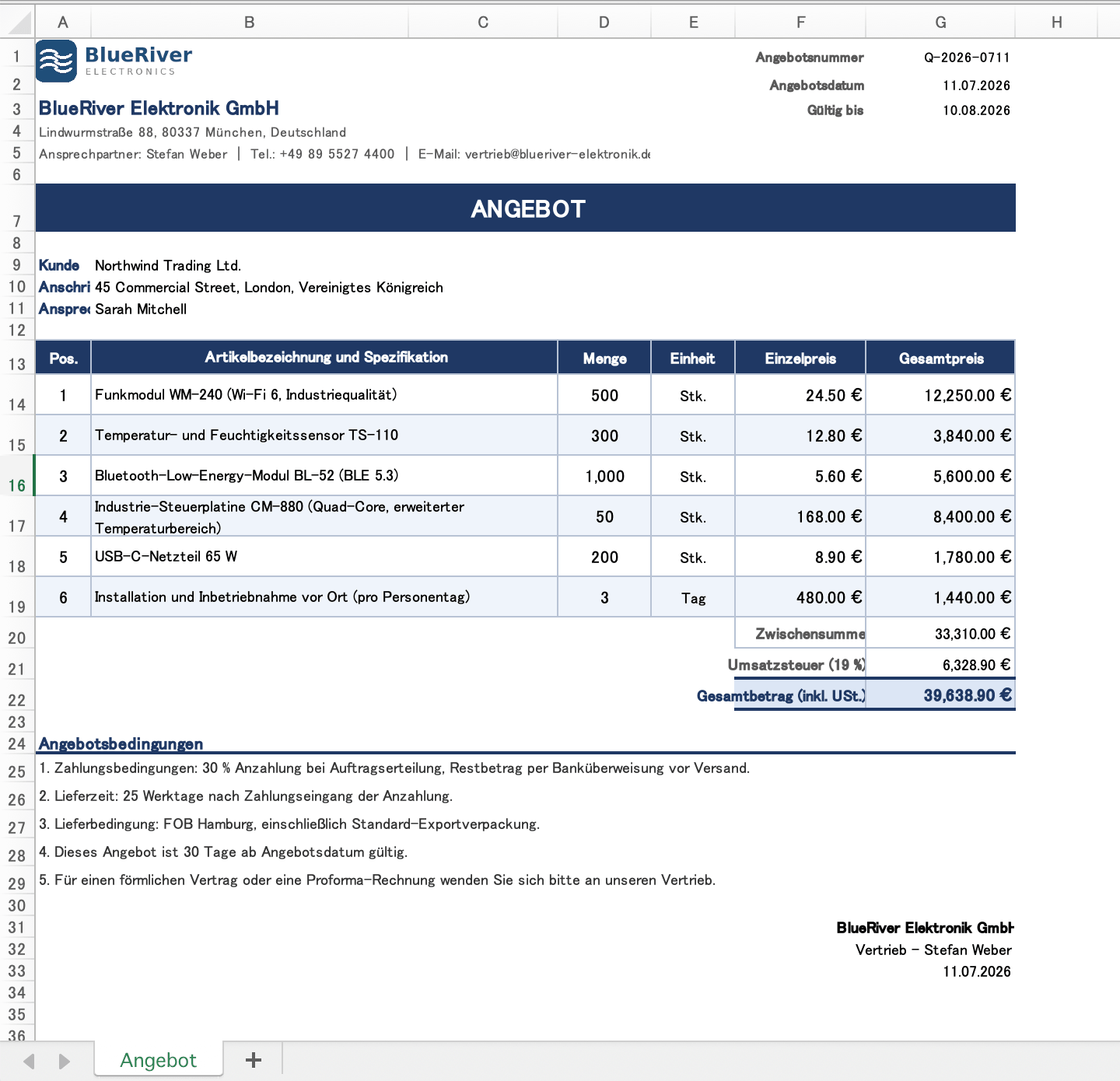
Each version is a fictional BlueRiver Electronics subsidiary quoting a UK buyer, Northwind Trading. Nothing about them is random. Each was built so that everything that typically breaks in translation is present:
- A merged, dark-blue title bar spanning seven columns
- Six product line items plus one service line billed per person-day
- An amount column made of formulas, not typed numbers:
=quantity × unit priceon every row,SUMfor the subtotal,ROUNDfor the tax, and an addition for the grand total - Local currency formatting (¥, ₩, €, R$), local date formatting, and an embedded company logo
- Five paragraphs of quotation terms: 30% deposit, 25 working days, FOB shipping, 30-day validity, pro forma invoice
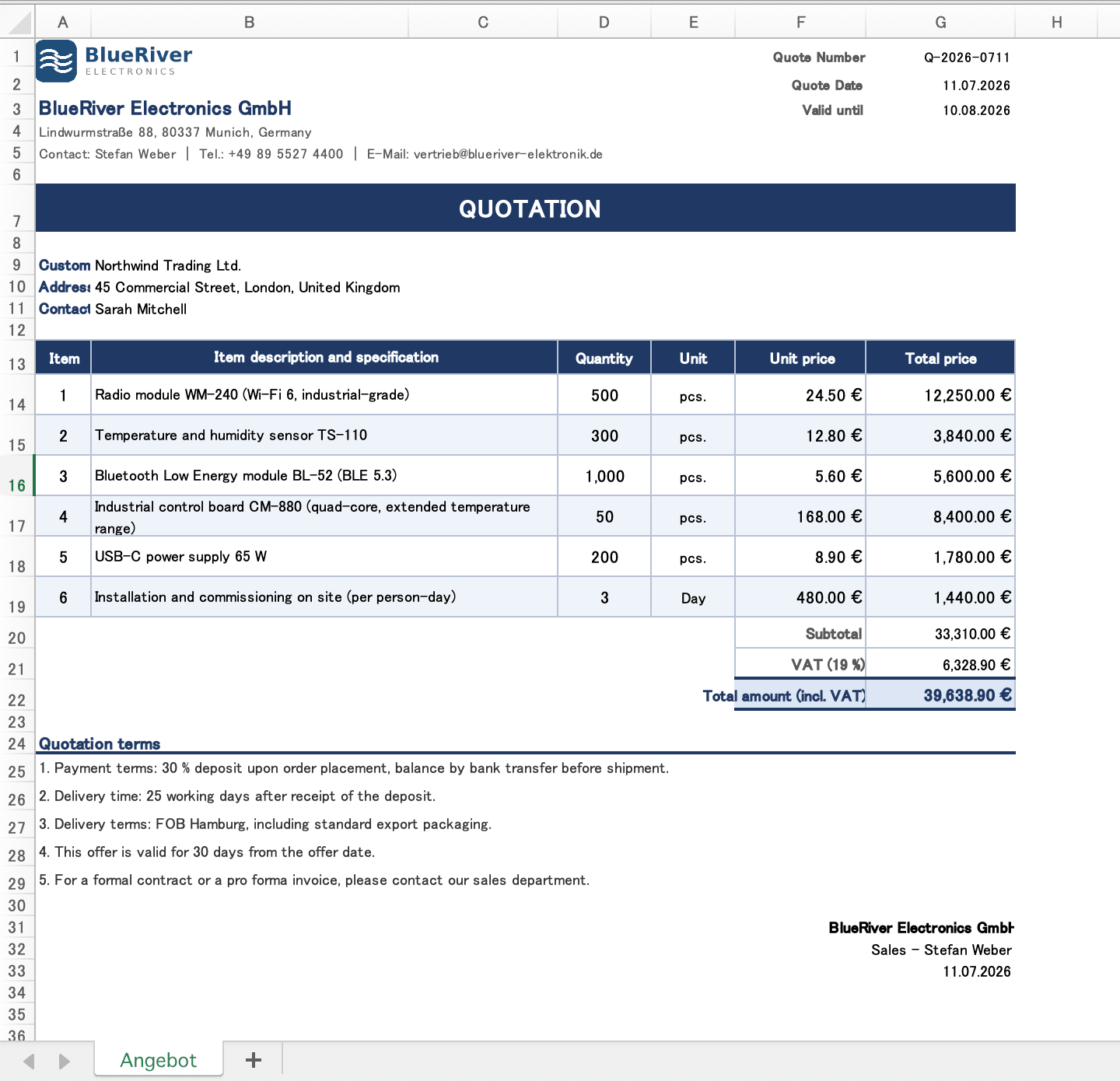
Here is the German one before translation, and the English file that came back.
What survived, in all eight files
We unzipped every output and compared it against its source. This part was consistent across all eight languages:
| Checked | Result across all 8 languages |
|---|---|
| Merged cells | 23 of 23 preserved, in every file |
| Line-item formulas | =D14*F14 still a live formula |
| Subtotal / tax / total | SUM, ROUND and the total all intact |
| Currency format | Untouched (¥, ₩, €, R$) |
| Embedded logo | Same position and size |
That is the whole point. The formulas are still formulas. Change a quantity and the total recalculates. Paste a table into ChatGPT and back into Excel and you lose that: the total arrives as a dead number. All 23 merged cells survived, so the header did not collapse.
What it got right
It is worth being specific about this too, because it is the part a generic translator gets wrong:
- Tax names are country-correct, not generalised. The European files say VAT. The Japanese file says Consumption tax, which is the actual name of the Japanese regime, not VAT. The Brazilian file kept ICMS, the local state tax, rather than flattening it into "sales tax". A tool that wrote "VAT" on all eight would have been factually wrong on two of them.
- Incoterms were left alone. FOB Hamburg, FOB Yokohama, FOB Shenzhen. These are legal shipping terms and translating them would be a mistake.
- "Pro forma invoice" stayed a pro forma invoice, and was not "corrected" into a formal invoice, which is a different document entirely.
If your company has fixed English wording (a house term for a part family, an agreed name for a tax line), do not leave it to chance on every run. Load a custom industry glossary at upload time and the same source term maps to the same English word across files and across months. That consistency is what matters when you are translating a stack of supplier quotes rather than one.
How to translate an Excel file to English
Upload and configure. Open the Excel translation tool, drop in the .xlsx (.xls, .xlsm, .xltx and .csv work too), and set the source language and English as the target. Three optional settings are worth a minute: the model (Pro for accuracy, Lite for up to 80% lower cost), the style (use Formal for quotations and contracts), and a glossary if your company has fixed English terms.
Preview for free. Part of the file is translated at no cost and shown side by side with the original. Do your quality check here, not after paying: company names, part numbers, and the terms that matter to your contract. If something is off, adjust the glossary and rerun.
Pay and download. Per-file pricing, no subscription and no account required. Files are deleted automatically after 14 days, which matters when the spreadsheet contains a customer's name and pricing.
When not to use this
- Contracts that will be signed. Machine translation saves you 90% of the typing, but have a professional review anything with liability clauses. A quotation is fine. A contract is not.
- The numbers. The tool does not alter values, but check the total, the tax rate and the delivery window against the source anyway. Thirty seconds of your time against the cost of getting it wrong.
- A bare list of words. If your spreadsheet is one column of product names with no formatting, use anything you like. The value of a file translator is that it protects structure. No structure, no benefit.
How it compares to ChatGPT and Google Translate
We ran a real Apple 10-Q filing (27 sheets) through six methods side by side. ChatGPT produced excellent prose but left 109 cells untranslated in the file. Claude went further and deleted all 322 merged cells while stripping currency formats down to raw numbers. Google Translate is free and fast but weakest on domain terminology, and DeepL only supports Excel from the Advanced plan up, where it flattens formulas into fixed values.
The numbers and screenshots are in our comparison of six Excel translation methods. If you are translating financial statements rather than quotations, translating an Excel financial report is closer to your case.
FAQ
How do I translate a whole Excel sheet to English?
Excel's own feature (Review → Translate) only handles the single selected cell and has no whole-sheet option. To do the entire workbook at once you need a tool that translates at file level: upload the .xlsx, pick the source language and English, and download the translated file with its formatting and formulas intact.
Do the formulas still work after translation?
Yes. In all eight files we checked, the per-row =quantity × price, the SUM subtotal and the ROUND tax line came back as live formulas, so changing a quantity recalculates the total. Copying a table into ChatGPT and pasting it back does not preserve this: the formulas arrive as fixed numbers.
Which source languages can be translated into English?
Over 100. This article covers Chinese, Japanese, Korean, German, French, Spanish, Italian and Portuguese specifically, because those are the source languages we tested end to end. The structural results (merged cells, formulas, formats) were identical in all eight.
Is it free?
You preview part of the translation free and only pay per file once you are happy with the quality. No subscription, no signup. The Lite model cuts the cost by up to 80%; use Pro for anything a client will read.
Will it convert the currency to dollars?
No, and it should not. Translation handles text; the amounts and the currency formatting stay exactly as they were. Exchange rates move daily, so a tool that quietly converted them would be dangerous. Convert the figures yourself if you need to.
Check it yourself
You do not have to trust any of this. Both German files are here. Open them in Excel, click the total to see whether the formula survived, check that the merged header is still merged, and confirm the euro formatting is untouched.
Translate your Excel file to English
Formulas, merged cells and formatting stay intact. Free preview before you pay, no signup.