Best Excel Translation Tools in 2026: 6 Methods Compared
We translated a real Apple 10-Q Excel report into Japanese with six methods, from Excel's built-in translator to ChatGPT, Claude, Google, DeepL and Doc2Lang. Here are the real results, with screenshots.
Anyone who has tried translating a large Excel spreadsheet knows the core frustration: Excel's built-in translator only works on one cell at a time. For a workbook with hundreds of rows across multiple sheets, that is not a viable approach.
To find out which method actually works, we took a real Apple Inc. Form 10-Q financial report (27 sheets, filed with the SEC on May 1, 2026) and translated it from English to Japanese with six different methods. We compared them on three things: translation quality, translation completeness, and whether the output file kept the original formatting. Everything below was checked against the actual downloaded files, not guessed.
The short version
- Excel's built-in translator only does one selected cell at a time, so it is fine for spot checks and useless for a whole file.
- ChatGPT and Claude write the best Japanese, but the file itself is unreliable: ChatGPT left 109 cells in English, and Claude deleted every merged cell and stripped the number formats.
- Google Translate is free and covers the whole file, but its accounting terminology is the weakest of the group.
- DeepL is excellent for European languages but needs a paid Advanced plan for Excel, and it flattens formulas to plain values.
- Doc2Lang matched the AI chatbots on quality while keeping all 322 merged cells and every currency format, with a free preview and no subscription.
Quick comparison
| Tool / Method | Whole file | Formatting kept | Coverage | Price | Best for |
|---|---|---|---|---|---|
| Excel built-in | One cell at a time | Kept, but manual | n/a | Free | A few cells |
| =TRANSLATE() + VBA | Semi-automatic | Kept | Good | Free (Microsoft 365) | Technical M365 users |
| ChatGPT / Claude | File upload | Unreliable | Incomplete | Plus / Pro plan | Small tables, best text quality |
| Google Translate | Yes | Mostly | Thorough | Free | Quick rough draft |
| DeepL (Advanced) | Yes | Kept, formulas flattened | Good | From about €23/month | European languages |
| Doc2Lang | Yes | Kept | Near-complete | Pay per file, free preview | Professional use |
If you already know you want the whole workbook translated with its formatting intact, you can translate Excel files online and preview the result for free before paying. Otherwise, read on for how each method did.
1. Excel's built-in translator
Type: Built into Microsoft Excel (Review tab)
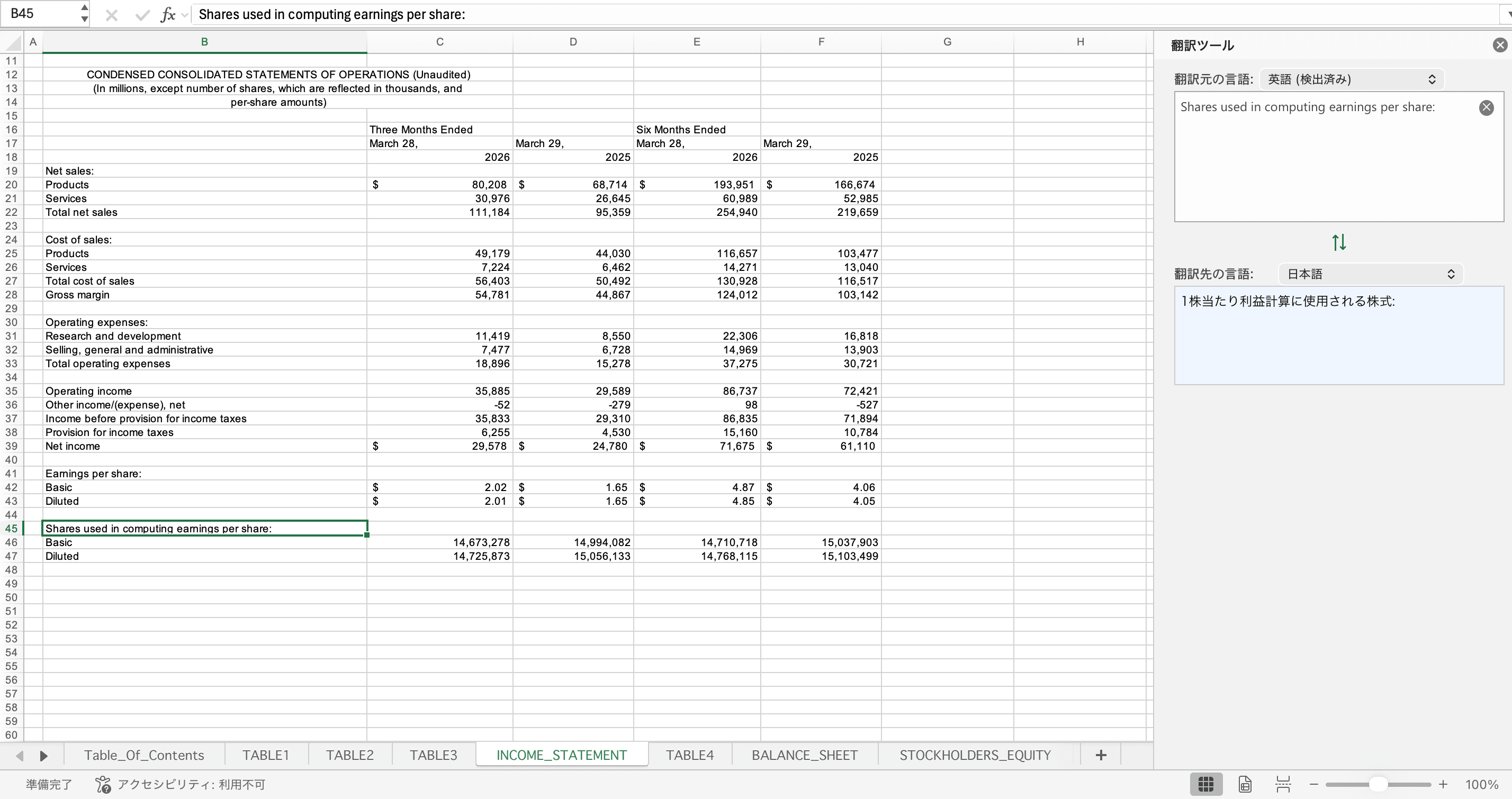
Select a cell, go to Review → Translate, and the Translator pane opens on the right. You choose a target language, then copy the translated text back into the cell by hand. Then you repeat that for the next cell.
What we liked
- Zero setup, it is already in Excel.
- Because you paste manually, the file structure stays untouched.
What did not work
- There is no "translate everything" option. Microsoft's own documentation confirms that translation only applies to the selected cell. For a 500-row sheet across three columns, that is 1,500 manual copy-and-paste steps.
- The engine is basic Microsoft Translator: fine for simple phrases, unreliable for technical terminology.
Bottom line: useful only for checking what a few cells say. Not a real method for a full file.
2. =TRANSLATE() function plus a VBA macro
Type: Free, built into Microsoft 365
In 2024, Microsoft added a native =TRANSLATE() function. Combined with a short VBA macro, it can walk an entire worksheet automatically.
=TRANSLATE(A1, "en", "ja")That translates cell A1 from English to Japanese. For a real workbook, a macro is more practical:
Sub TranslateSheet()
    Dim ws As Worksheet, cell As Range, newWs As Worksheet
    Dim targetLang As String

    targetLang = InputBox("Enter target language code (e.g., en, es, ja):")
    Set ws = ActiveSheet
    ws.Copy After:=ws
    Set newWs = ActiveSheet
    newWs.Name = ws.Name & "_" & targetLang

    For Each cell In newWs.UsedRange
        If Not IsEmpty(cell.Value) And Not IsNumeric(cell.Value) Then
            On Error Resume Next
            cell.Formula = "=TRANSLATE(" & ws.Name & "!" & cell.Address & ",""auto"",""" & targetLang & """)"
            On Error GoTo 0
        End If
    Next cell
End Sub
What we liked
- Completely free with Microsoft 365, and it stays inside Excel, so styles and merged cells are preserved.
- It works on a copy, so your original data is safe.
What did not work
- Requires Microsoft 365 with an internet connection. It is not in older Excel versions.
- Large sheets (1,000+ cells) can take minutes and sometimes time out.
- The original values are replaced by
=TRANSLATE(...)formulas rather than plain text, and the file must be saved as.xlsm.
For a complete walkthrough, see our step-by-step Excel VBA translation guide.
Bottom line: the best free option for Microsoft 365 users who are comfortable with macros.
3. ChatGPT and Claude (AI chatbots)
Type: AI chatbot with file upload (ChatGPT Plus / Claude Pro)
ChatGPT and Claude are the most capable AI translators available today. Their grasp of context and domain terminology genuinely beats traditional machine translation. But using them to translate Excel files, not just the text inside, exposes structural limits that matter for professional work.
We uploaded the Apple 10-Q to both tools and asked them to translate all text to Japanese, keep the numbers and formatting, and return a downloadable .xlsx.
The translation quality was excellent, but the coverage was not complete.
Both tools correctly used formal accounting terms such as 売上原価 (cost of sales), 売上総利益 (gross margin), 営業利益 (operating income) and 販売費及び一般管理費 (SG&A). That is a level of domain knowledge Google Translate often misses.
Coverage, however, was another story:
- ChatGPT left 109 cells in English. "APPLE INC." stayed untranslated on all 27 sheets. Every date header ("March 28,", "March 29,", "September 27,") stayed in English across every statement. In one sheet a single sentence came out half Japanese and half English:
December 28, 2025からJanuary 31,, with the Japanese particle から wedged between two English dates. - Claude left about 10 cells untranslated. Most were proper nouns (iPhone®, Mac®, iPad®, the ticker AAPL, an address), which is correct. But one was a real balance-sheet line item, "Other non-current liabilities", left in English in the middle of an otherwise fully translated statement.
The terminology was also not perfectly consistent between the two. ChatGPT rendered "Net income" as 純利益 rather than the standard 当期純利益, and "Provision for income taxes" as 法人所得税引当額 rather than the more common 法人税等. Claude shortened "Marketable securities" to 市場性証券 instead of the full 市場性のある有価証券. None of these are outright wrong, but the inconsistency is a problem when the same report is shared across teams that expect standardized terms. A custom glossary for industry terms is what fixes this, and neither chatbot offers one across sessions.
Formatting preservation was unpredictable, and this is where the two tools split sharply.
ChatGPT preserved the structure well: all 322 merged cells and the currency number formats survived. Claude did not. It rebuilt the workbook from scratch, deleting all 322 merged cells and stripping every accounting currency format, so $80,208 came out as a plain 80208.
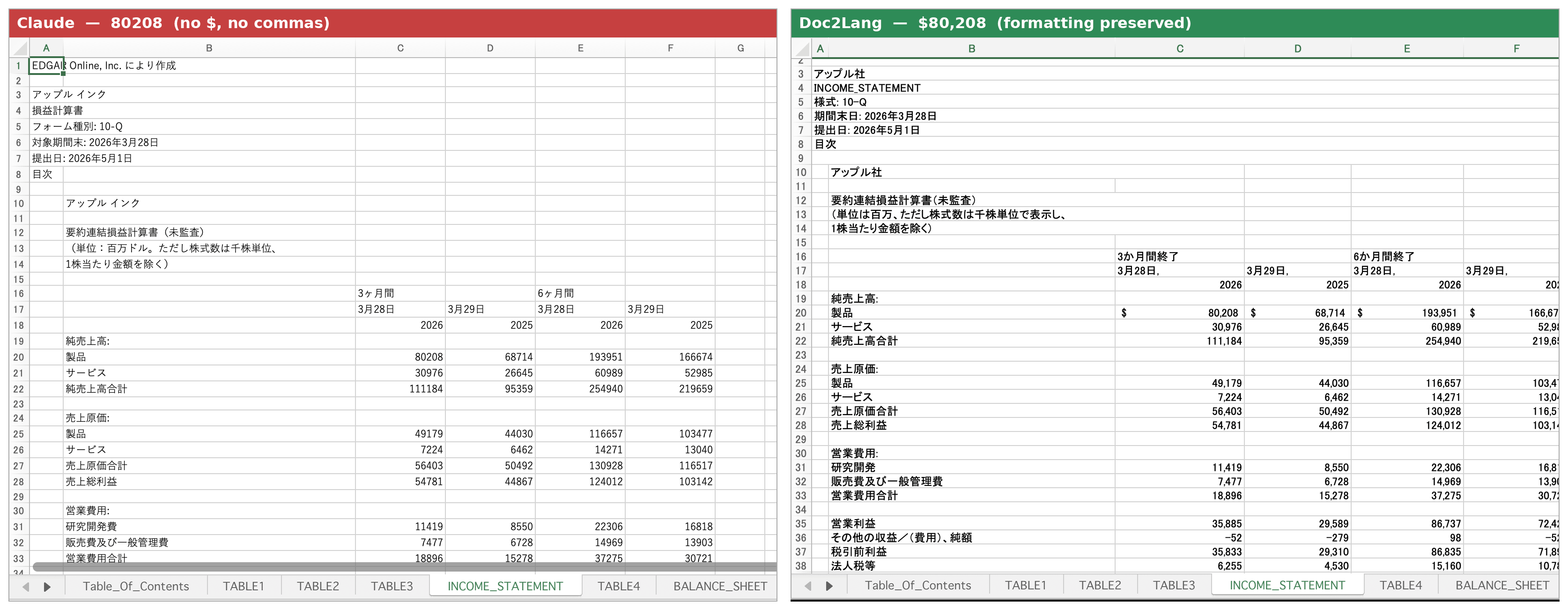
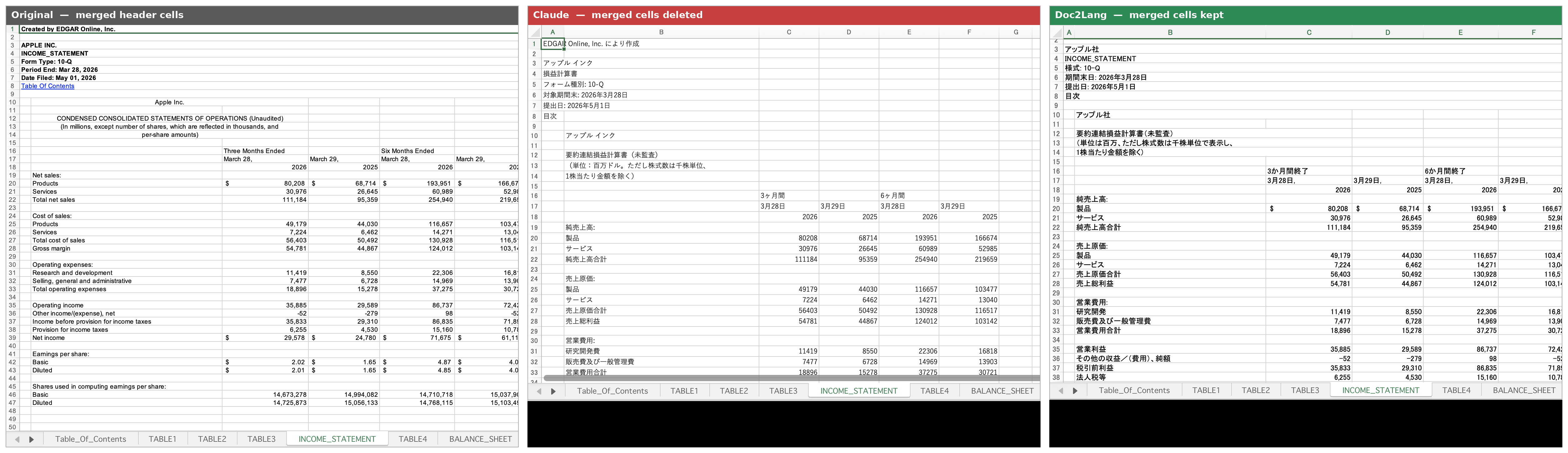
The Claude file opened and was readable, but it no longer looked like the original spreadsheet: no merged headers, plain numbers, and the font swapped to a default Japanese face.
Other limits that apply to both
- Neither supports
.xls. You have to convert to.xlsxbefore uploading. - No way to exclude specific rows, columns or sheets.
- No terminology memory across sessions, so translating a big file in batches can drift.
- You are uploading potentially sensitive business data to a third-party chat service.
Bottom line: ChatGPT and Claude produce the best language on this list, for the cells they actually translate. But translating a spreadsheet is a file-processing job, not just a language job. The text is excellent; the file is a gamble. For anything important, you would have to check every cell and possibly rebuild the formatting, which defeats the point of automating it.
4. Google Translate (file upload)
Type: Free online service
Open translate.google.com, go to the Documents tab, upload your .xlsx (it does not accept .xls, so convert first), choose the languages, and download the result.
What we liked
- Free, no account, 130+ languages.
- It translated every sheet, including the sheet tab names (目次, 損益計算書, 貸借対照表).
- Coverage was thorough, with no obvious cells left in English.
What did not work
- The terminology was the weakest of the group. "Gross margin" came out as the colloquial 粗利益 instead of the standard 売上総利益. "Selling, general and administrative" was shortened to 販売、一般管理, dropping the 費 (expenses) suffix that Japanese accounting requires.
- Only
.xlsxis supported, so legacy.xlsfiles (common in SEC EDGAR exports and older systems) have to be converted first. - No way to exclude specific cells, columns or sheets, and no controls for keeping terminology consistent.
Bottom line: handy for a quick, free draft when you just need to understand what a spreadsheet says. Not reliable for professional use because of the terminology quality.
5. DeepL Pro (file translation)
Type: Paid subscription (Excel needs the Advanced plan, from about €22.99/month)
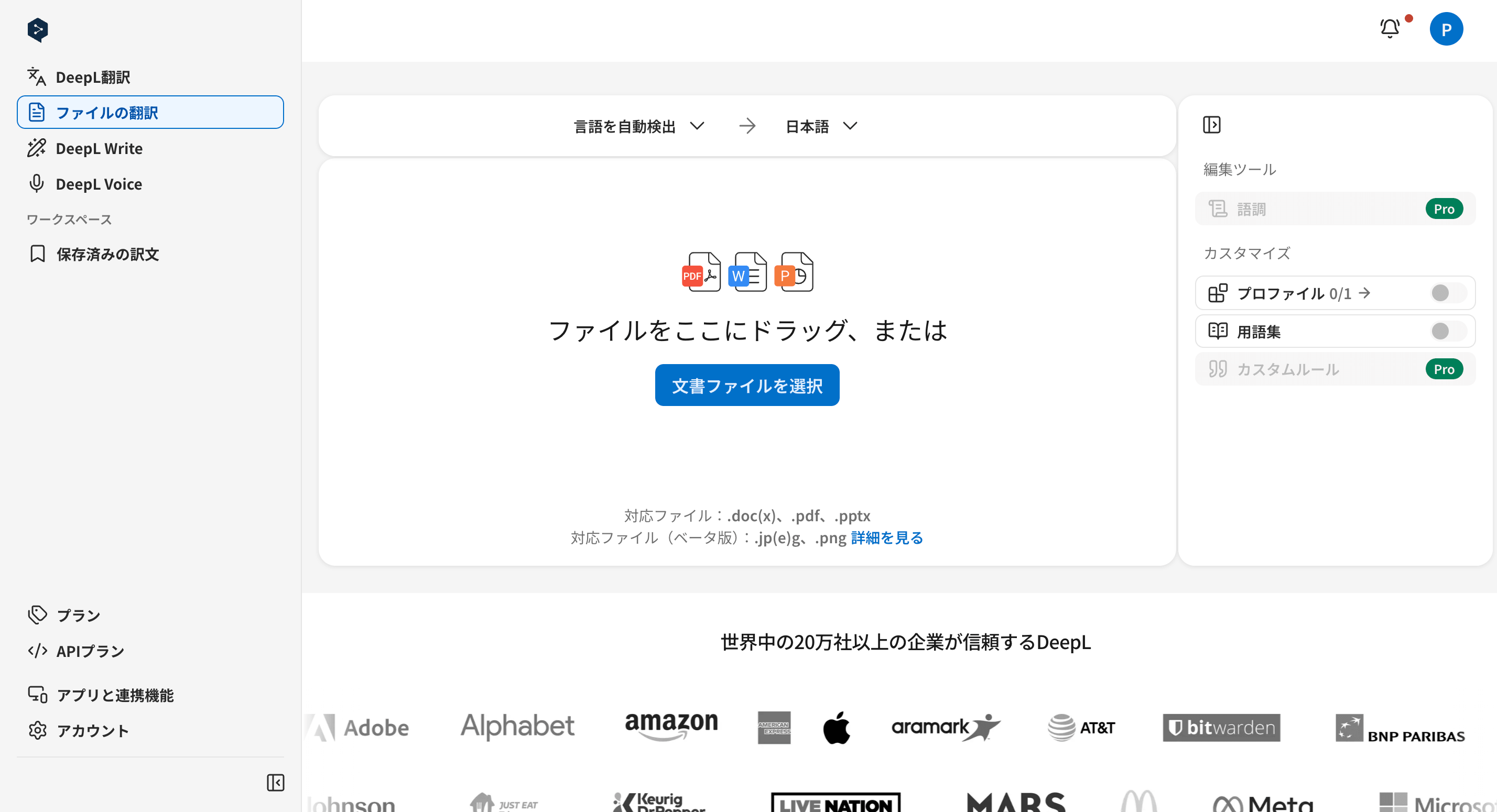
Log into a DeepL Pro Advanced account, open Translate files, upload your .xlsx, choose the target language, and download.
What we liked
- Translation quality for European language pairs (English with German, French, Spanish, Italian, Dutch, Portuguese) is among the best available.
- Formatting (cell styles, merged cells, column widths) is generally well kept.
- A glossary feature lets you fix how specific terms are always translated.
- It translates every sheet in the workbook, including tab names.
What did not work
- Excel needs a Pro Advanced, Ultimate, Team or Business plan (DeepL Help Center). The Free tier and the Starter plan (about €8.99/month) do not support Excel at all; the upload page lists only
.doc(x),.pdfand.pptx. - Formulas are flattened. DeepL's documentation states plainly: "Formulas will not be applied in the translated file. Only the result of the formula will be visible in the translation." A
=SUM(B2:B9)becomes a static number. For a financial model that needs to stay live, that is a serious limitation. - Only
.xlsxis accepted;.xlsand.xlsmare not. - Language coverage is roughly 33 languages. Hindi, Thai and Vietnamese are not supported.
- No option to exclude specific rows, columns or sheets, so hidden columns and sheets get translated too.
Bottom line: the strongest choice for frequent European-language work where formulas do not need to survive. The formula flattening rules it out for live financial models, and the language coverage and subscription cost make it a poor fit for Asian languages or one-off jobs.
6. Doc2Lang (AI-powered file translation)
Type: Online service, pay per use
Go to Doc2Lang's Excel translator, upload your file (it accepts .xlsx, .xls, .xlsm, .xltx, .csv and more), pick one of 100+ target languages, preview a sample for free, then pay for that one file and download the full translation.
If your table is only available as a screenshot or photo, first extract the image into an editable Excel or CSV table. Check the cells against the image before translating the resulting spreadsheet; extraction does not preserve the original formatting or merged cells.
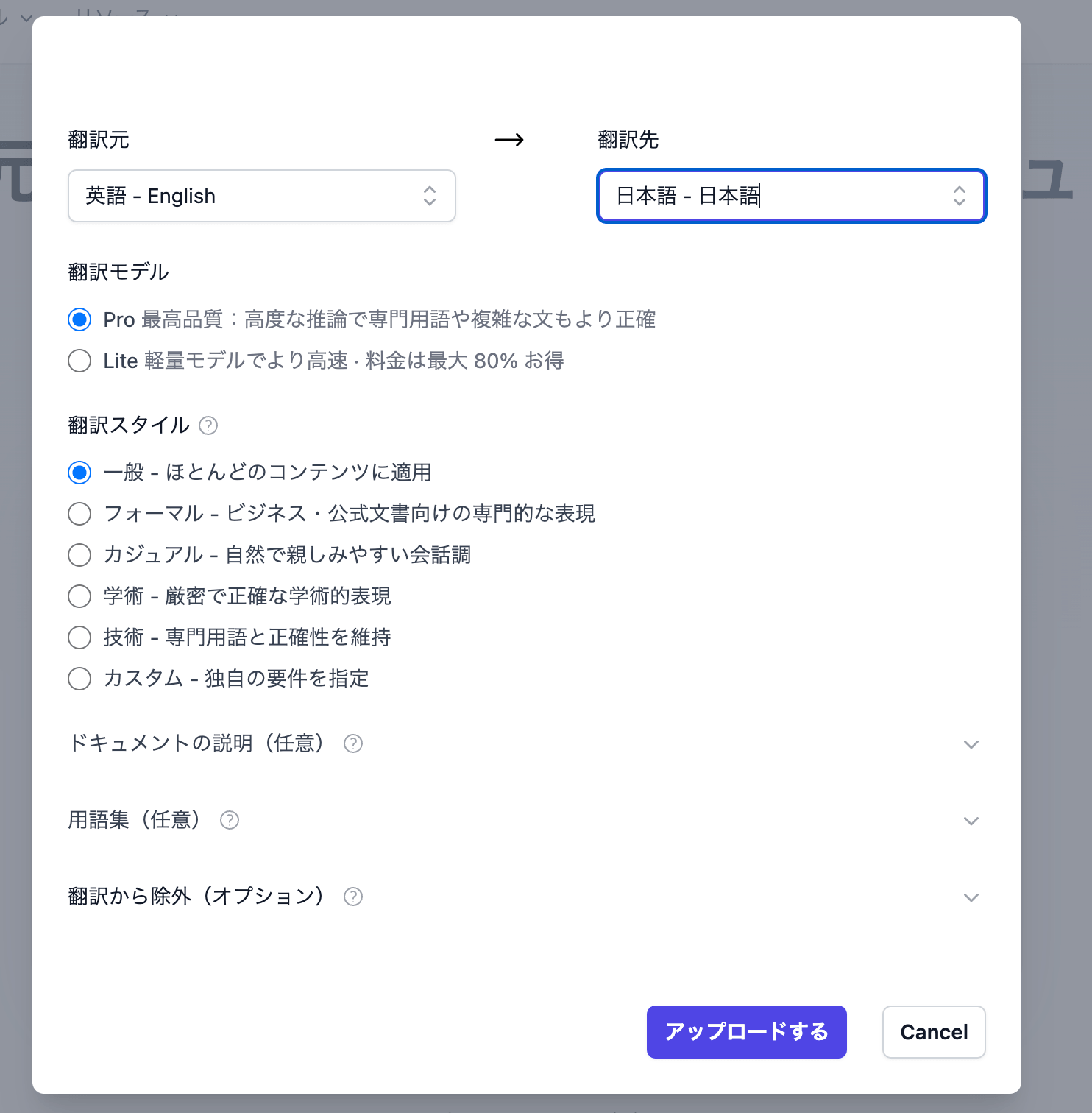
We tested Doc2Lang with the same Apple 10-Q used above.
Translation quality matched the AI chatbots, with better consistency.
Doc2Lang uses large language models, so the quality is comparable to ChatGPT and Claude. On this file it stayed closer to standard Japanese accounting usage: 当期純利益 for "Net income" (rather than ChatGPT's 純利益), 市場性のある有価証券 for "Marketable securities" (rather than Claude's shortened 市場性証券), and 法人税等 for "Provision for income taxes" (rather than ChatGPT's 法人所得税引当額).
About 13 cells stayed in English. Most were exactly what should stay in English (iPhone®, iPad®, the ticker AAPL, RSU), along with a couple of internal labels. In other words, it did not blindly translate proper nouns and product names.
Format preservation was complete. All 322 merged cells were kept, every currency format displayed correctly ($80,208), and the column widths matched the original (you can see this in the right-hand panel of the comparison screenshots above). This is the practical difference between a dedicated file translator and a chatbot: Doc2Lang processes the Excel file as a file, not as text pasted into a conversation.
The free preview is the part that de-risks it. Before paying, you see the translation side by side with the original text and can adjust the style and preview again.

What else sets it apart
- No subscription. Pay only when you translate. One file today, another in three months, no monthly fee.
- Two modes. Pro uses the latest models for maximum accuracy, ideal for financial reports and client-facing work. Lite is up to 80% cheaper and fine for internal drafts and high-volume batches. You pick per file.
- Selective translation. Exclude specific rows or sheets, which matters when ID columns, SKU codes or monetary values must stay untouched.
- Chart and graph text. Axis labels, chart titles and legends are translated too.
- Batch processing. Upload a ZIP of several Excel files at once.
- Native
.xlssupport. It is the only tool here that accepts legacy.xlsfiles without converting them first.
Bottom line: it combines AI-quality translation with reliable file processing. The free preview, pay-per-use pricing (with Lite up to 80% cheaper for less critical files) and complete format preservation make it the most practical option for professional Excel translation without a subscription.
Translate your Excel file with its formatting intact
Upload once, preview the translation for free, and pay only for the file you need. No subscription.
Which method should you use?
- Translate a few cells: Excel's built-in translator (Method 1).
- Technical user on Microsoft 365: =TRANSLATE() plus VBA (Method 2).
- Best text quality for a small table you can copy and paste: ChatGPT or Claude (Method 3).
- A quick, free understanding of a file: Google Translate (Method 4).
- Frequent European-language translation: DeepL Advanced (Method 5).
- A professional file that must keep its formatting, with no subscription: Doc2Lang (Method 6).
If keeping the layout intact is your main worry, this deeper look at AI translation that keeps your formatting explains why some tools rebuild the file and others do not.If the file landing on your desk is the foreign one, we ran the reverse test too: the same quotation in eight languages, all translated into English, with the five things you have to fix by hand afterwards.
Frequently asked questions
Can Excel translate an entire worksheet at once?
No. Excel's built-in translator only handles one selected cell at a time. The =TRANSLATE() function with a VBA macro can automate it, but it needs Microsoft 365. External tools like Google Translate, DeepL and Doc2Lang translate the whole file in one pass.
Can ChatGPT or Claude translate an Excel file?
They translate the text with excellent quality, but the file output is unreliable. In our test ChatGPT left 109 cells in English, and Claude deleted every merged cell and stripped the number formats. Both produced usable translations, but neither produced a file you could ship without a manual review.
Will my formatting and formulas survive translation?
It depends on the tool. Claude rebuilt our file and lost the merged cells and number formats; Google can also break formatting. DeepL keeps the visual formatting but, by its own documentation, flattens formulas so a =SUM() becomes a static number. In our test, Doc2Lang kept the merged cells and currency formats intact. If live formulas matter, translate a copy and confirm the result before relying on it.
What is the best free way to translate an Excel file?
For formatting, the =TRANSLATE() plus VBA method keeps everything because it runs inside Excel. For a quick rough draft, Google Translate is free and fast. Doc2Lang lets you preview the quality for free before you decide to pay.
Can I translate Excel files to or from Japanese, Korean or Hindi?
DeepL does not support Hindi. Google Translate, ChatGPT, Claude and Doc2Lang all handle Japanese, Korean and Hindi. For CJK languages, a tool with context-aware AI and full format preservation gives the most usable result.
My file is in the old .xls format. Which tools accept it?
Only Doc2Lang accepts .xls directly. Every other tool here needs .xlsx, so you would open the file in Excel and re-save it before uploading.
Conclusion
The best method depends on what you are protecting. If you only care about the words, ChatGPT and Claude write the best Japanese. If you care about the file, the layout, the merged cells and the currency formats, then a dedicated Excel translator is the safer choice. In our test the tool that kept both the language quality and the file intact was Doc2Lang's Excel translator, and you can check the quality on your own file with a free preview before paying.
Last updated: July 2026. Test file: Apple Inc. Form 10-Q (Q2 2026), SEC EDGAR filing, public domain. All cell counts and formatting claims were checked against the actual downloaded files.